
![Cops]() Cops
Cops
Container
Cops by Sébastien Lucas, now maintained by MikesPub, stands for Calibre OPDS (and HTML) Php Server. COPS links to your Calibre library database and allows downloading and emailing of books directly from a web browser and provides a OPDS feed to connect to your devices. Changes in your Calibre library are reflected immediately in your COPS pages. See : COPS's home for more details. Don't forget to check the Wiki. ## Why? (taken from the author's site) In my opinion Calibre is a marvelous tool but is too big and has too much dependencies to be used for its content server. That's the main reason why I coded this OPDS server. I needed a simple tool to be installed on a small server (Seagate Dockstar in my case). I initially thought of Calibre2OPDS but as it generate static file no search was possible. Later I added an simple HTML catalog that should be usable on my Kobo. So COPS's main advantages are : No need for many dependencies. No need for a lot of CPU or RAM. Not much code. Search is available. With Dropbox / owncloud it's very easy to have an up to date OPDS server. It was fun to code. If you want to use the OPDS feed don't forget to specify /feed at the end of your URL.
Image details
Source details
Configuration
TypeContainerlinuxlinuxserver/cops:latest80:80/tcp443:443/tcp/config : /srv/lsio/cops/config/books : /srv/lsio/cops/booksPUID=1000PGID=1000TZ=Etc/UTCunless-stoppedTemplate by technorabilia
Report issueNotes
Ensure to create the following volume directories on the host file system, or modify the paths in the volume mapping section under the advanced options below, as needed.
mkdir -p /srv/lsio/cops/config
mkdir -p /srv/lsio/cops/books
Standalone Install
Select an install method, to see config/commands for deploying Cops
Install on Portainer
Import all app templates into your Portainer instance, for easy 1-click deploys
- Ensure both Docker and Portainer are installed, and up-to-date
- Log into your Portainer web UI
- Under Settings → App Templates, paste the below URL
- Head to Home → App Templates, and the list of apps will show up
- Select Cops, fill in any config options, and hit Deploy
Template Import URL
https://raw.githubusercontent.com/Lissy93/portainer-templates/main/templates.json
Show Me
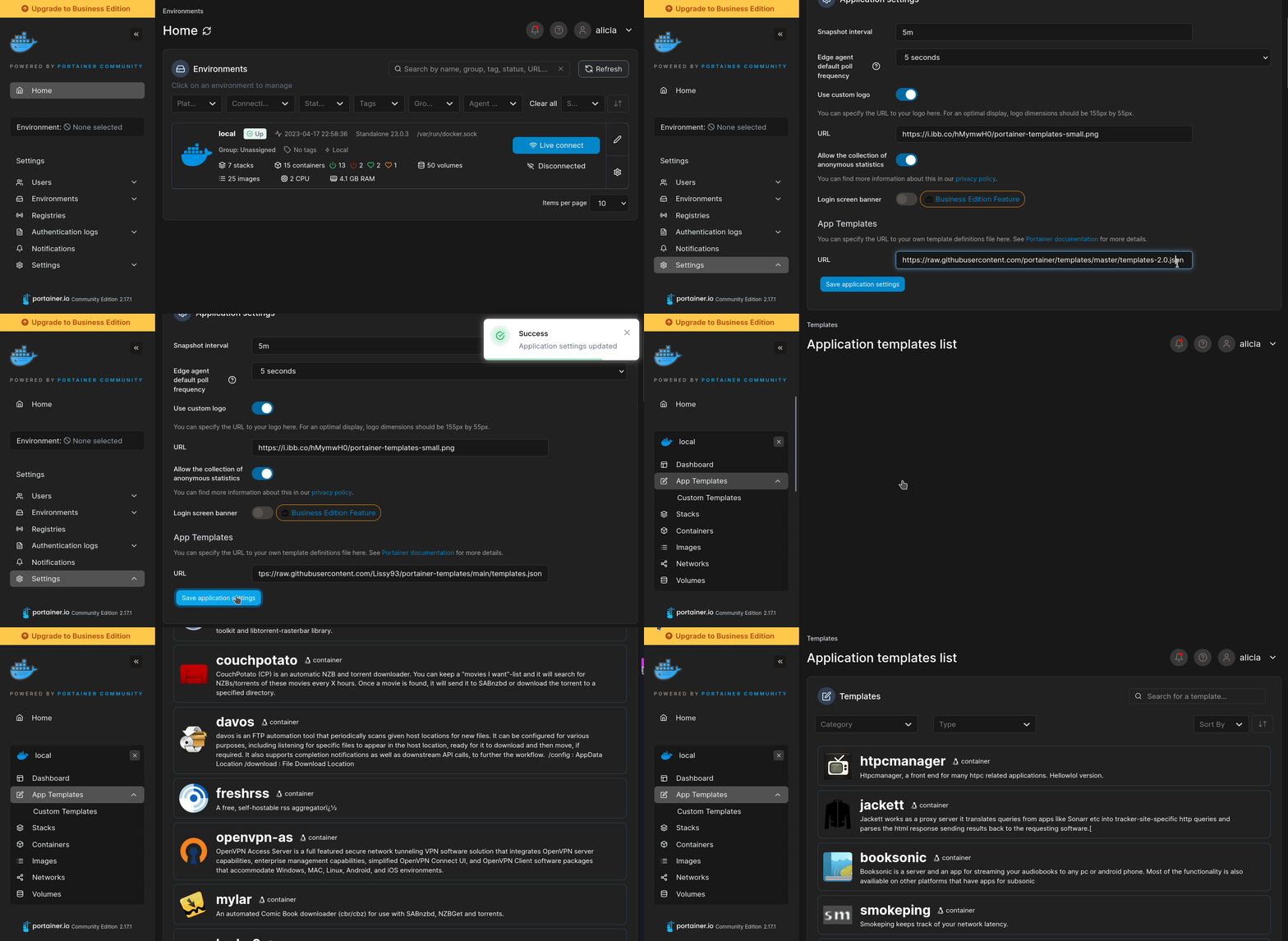
More install options in our documentation, or see mikespub-org/seblucas-cops for app-specific guidance.






The LinuxServer.io team brings you another container release featuring:
- regular and timely application updates
- easy user mappings (PGID, PUID)
- custom base image with s6 overlay
- weekly base OS updates with common layers across the entire LinuxServer.io ecosystem to minimise space usage, down time and bandwidth
- regular security updates
Find us at:
- Blog - all the things you can do with our containers including How-To guides, opinions and much more!
- Discord - realtime support / chat with the community and the team.
- Discourse - post on our community forum.
- GitHub - view the source for all of our repositories.
- Open Collective - please consider helping us by either donating or contributing to our budget
linuxserver/cops









Cops by Sébastien Lucas, now maintained by MikesPub, stands for Calibre OPDS (and HTML) Php Server.
COPS links to your Calibre library database and allows downloading and emailing of books directly from a web browser and provides a OPDS feed to connect to your devices.
Changes in your Calibre library are reflected immediately in your COPS pages.
See : COPS's home for more details.
Don't forget to check the Wiki.
Why? (taken from the author's site)
In my opinion Calibre is a marvelous tool but is too big and has too much dependencies to be used for its content server.That's the main reason why I coded this OPDS server. I needed a simple tool to be installed on a small server (Seagate Dockstar in my case).
I initially thought of Calibre2OPDS but as it generate static file no search was possible.
Later I added an simple HTML catalog that should be usable on my Kobo.
So COPS's main advantages are : No need for many dependencies. No need for a lot of CPU or RAM. Not much code. Search is available. With Dropbox / owncloud it's very easy to have an up to date OPDS server. It was fun to code.
If you want to use the OPDS feed don't forget to specify /feed at the end of your URL.

Supported Architectures
We utilise the docker manifest for multi-platform awareness. More information is available from docker here and our announcement here.Simply pulling
lscr.io/linuxserver/cops:latest should retrieve the correct image for your arch, but you can also pull specific arch images via tags.The architectures supported by this image are:
| Architecture | Available | Tag |
|---|---|---|
| x86-64 | ✅ | amd64-\ |
| arm64 | ✅ | arm64v8-\ |
Application Setup
Access the webui athttp://<docker host ip>:80. For connecting via OPDS on a mobile device use http://<docker host ip>:80/index.php/feed or http://<docker host ip>:80/feed. It is strongly suggested that you reverse proxy this prior to exposing to the internet. For more information, such as requiring credentials, check the COPS Wiki (linked above).The linuxserver version gives you access to
config/local.php in /config to customise your install to suit your needs, it also includes the dependencies required to directly view epub books in your browser.Usage
To help you get started creating a container from this image you can either use docker-compose or the docker cli.>!NOTE >Unless a parameter is flagged as 'optional', it is mandatory and a value must be provided.
docker-compose (recommended, click here for more info)
---
services:
  cops:
    image: lscr.io/linuxserver/cops:latest
    container_name: cops
    environment:
      - PUID=1000
      - PGID=1000
      - TZ=Etc/UTC
    volumes:
      - /path/to/cops/config:/config
      - /path/to/data:/books
    ports:
      - 80:80
      - 443:443
    restart: unless-stopped
docker cli (click here for more info)
docker run -d \
  --name=cops \
  -e PUID=1000 \
  -e PGID=1000 \
  -e TZ=Etc/UTC \
  -p 80:80 \
  -p 443:443 \
  -v /path/to/cops/config:/config \
  -v /path/to/data:/books \
  --restart unless-stopped \
  lscr.io/linuxserver/cops:latest
Parameters
Containers are configured using parameters passed at runtime (such as those above). These parameters are separated by a colon and indicate<external>:<internal> respectively. For example, -p 8080:80 would expose port 80 from inside the container to be accessible from the host's IP on port 8080 outside the container.| Parameter | Function |
|---|---|
-p 80:80 | HTTP WebUI |
-p 443:443 | HTTPS WebUI |
-e PUID=1000 | for UserID - see below for explanation |
-e PGID=1000 | for GroupID - see below for explanation |
-e TZ=Etc/UTC | specify a timezone to use, see this list. |
-v /config | COPS Application Data. |
-v /books | Calibre metadata.db location. |
Environment variables from files (Docker secrets)
You can set any environment variable from a file by using a special prependFILE__.As an example:
-e FILE__MYVAR=/run/secrets/mysecretvariableWill set the environment variable
MYVAR based on the contents of the /run/secrets/mysecretvariable file.Umask for running applications
For all of our images we provide the ability to override the default umask settings for services started within the containers using the optional-e UMASK=022 setting.
Keep in mind umask is not chmod it subtracts from permissions based on it's value it does not add. Please read up here before asking for support.User / Group Identifiers
When using volumes (-v flags), permissions issues can arise between the host OS and the container, we avoid this issue by allowing you to specify the user PUID and group PGID.Ensure any volume directories on the host are owned by the same user you specify and any permissions issues will vanish like magic.
In this instance
PUID=1000 and PGID=1000, to find yours use id your_user as below:id your_userExample output:
uid=1000(your_user) gid=1000(your_user) groups=1000(your_user)Docker Mods


We publish various Docker Mods to enable additional functionality within the containers. The list of Mods available for this image (if any) as well as universal mods that can be applied to any one of our images can be accessed via the dynamic badges above.
Support Info
- Shell access whilst the container is running:
```bash
docker exec -it cops /bin/bash
```- To monitor the logs of the container in realtime:
```bash
docker logs -f cops
```- Container version number:
```bash
docker inspect -f '{{ index .Config.Labels "build_version" }}' cops
```- Image version number:
```bash
docker inspect -f '{{ index .Config.Labels "build_version" }}' lscr.io/linuxserver/cops:latest
```
Updating Info
Most of our images are static, versioned, and require an image update and container recreation to update the app inside. With some exceptions (noted in the relevant readme.md), we do not recommend or support updating apps inside the container. Please consult the Application Setup section above to see if it is recommended for the image.Below are the instructions for updating containers:
Via Docker Compose
- Update images:
* All images:

    ```bash
    docker-compose pull
    ```

* Single image:

    ```bash
    docker-compose pull cops
```- Update containers:
* All containers:

    ```bash
    docker-compose up -d
    ```

* Single container:

    ```bash
    docker-compose up -d cops
```- You can also remove the old dangling images:
```bash
docker image prune
```
Via Docker Run
- Update the image:
```bash
docker pull lscr.io/linuxserver/cops:latest
```- Stop the running container:
```bash
docker stop cops
```- Delete the container:
```bash
docker rm cops
```- Recreate a new container with the same docker run parameters as instructed above (if mapped correctly to a host folder, your
/configfolder and settings will be preserved) - You can also remove the old dangling images:
```bash
docker image prune
```
Image Update Notifications - Diun (Docker Image Update Notifier)
>!TIP >We recommend Diun for update notifications. Other tools that automatically update containers unattended are not recommended or supported.Building locally
If you want to make local modifications to these images for development purposes or just to customize the logic:git clone https://github.com/linuxserver/docker-cops.git
cd docker-cops
docker build \
--no-cache \
--pull \
-t lscr.io/linuxserver/cops:latest .The ARM variants can be built on x8664 hardware and vice versa using
lscr.io/linuxserver/qemu-staticdocker run --rm --privileged lscr.io/linuxserver/qemu-static --resetOnce registered you can define the dockerfile to use with
-f Dockerfile.aarch64.Versions
- 21.07.26: - Rebase to Alpine 3.24.
- 10.06.26: - Existing users should verify: site-confs/default.conf and config/local.php - Update redirect location and use front controller.
- 08.02.26: - Existing users should update: site-confs/default.conf - Deny access to all dotfiles.
- 08.02.26: - Adding missing php-tokenizer package.
- 10.10.25: - Adding missing icu-data-full package.
- 10.07.25: - Rebase to Alpine 3.22.
- 14.05.25: - Existing users should verify: site-confs/default.conf and config/local.php - Clean-up default site conf and local.php.
- 16.12.24: - Rebase to Alpine 3.21.
- 24.09.24: - Existing users should verify: site-confs/default.conf - Update rewriting rules default site conf.
- 14.09.24: - Ensure user config files have the right permissions.
- 09.09.24: - In COPS 3.x, the configlocal.php is being moved over to config/local.php and this container will automatically migrate it. Existing users should verify: configlocal.php and/or config/local.php - define $config'copskepubifypath' if they want to use it
- 28.08.24: - Add kepubify tool to update metadata for Kobo - see mikespub-org/seblucas-cops#77
- 24.06.24: - Rebase to Alpine 3.20. Existing users should update their nginx confs to avoid http2 deprecation warnings.
- 07.05.24: - Existing users should verify: site-confs/default.conf - Fix rewriting rules default site conf.
- 20.03.24: - Rebase to Alpine 3.19.
- 25.12.23: - Existing users should update: site-confs/default.conf - Cleanup default site conf.
- 11.08.23: - Undeprecate and add new branch with mikespub fork which is actively maintained.
- 15.05.23: - Deprecate due to upstream dev abandonment of project.
- 13.04.23: - Move ssl.conf include to default.conf.
- 19.01.23: - Rebase to alpine 3.17 with php8.1.
- 20.08.22: - Rebasing to alpine 3.15 with php8. Restructure nginx configs (see changes announcement).
- 22.11.20: - Pin composer version to 1.10.17.
- 01.06.20: - Rebasing to alpine 3.12.
- 19.12.19: - Rebasing to alpine 3.11.
- 28.06.19: - Rebasing to alpine 3.10.
- 23.03.19: - Switching to new Base images, shift to arm32v7 tag.
- 27.02.19: - Upgrade packages during install to prevent mismatch with baseimage.
- 22.02.19: - Rebasing to alpine 3.9.
- 14.01.19: - Add multiarch and pipeline logic.
- 21.08.18: - Rebase to alpine 3.8.
- 02.07.18: - Add php7-ctype dependency.
- 08.01.18: - Rebase to alpine 3.7.
- 25.05.17: - Rebase to alpine 3.6.
- 03.04.17: - Add composer packages, reduce layers.
- 02.04.17: - Updated to version 1.1.0.
- 05.02.17: - Updated to Alpine 3.5 & PHP7.
- 24.10.16: - Updated to implement user based config.
- 24.10.16: - Updated to version 1.0.1.
- 14.10.16: - Add version layer information.
- 28.09.16: - Add php5-zlib.
- 11.09.16: - Add layer badges to README.
- 29.08.16: - Add php5-opcache.
- 28.08.16: - Add badges to README.
- 12.08.16: - Initial Release.
Serve Cops on your own domain behind Caddy, Nginx or Traefik. Fill in your domain and copy the result. It's a starting point, some apps need their own base URL or extra headers set too.
Proxying cops.example.com to http://Cops:80
Add this to your Caddyfile
cops.example.com {
	reverse_proxy http://Cops:80
}Check the logs first
Nine times out of ten the logs tell you exactly what went wrong.
- In Portainer, go to Containers, click the container, then Logs. Or run
docker logs Cops - Exit codes help too:
137means killed, usually out of memory.126or127means the command inside the image is broken.
Port already in use
If deployment fails with "Bind for 0.0.0.0:80 failed: port is already allocated", something else on your server is using that port.
- Find what's using it:
sudo ss -tlnp | grep :80 - Stop the other service, or pick a different host port. In
80:80only the left number is yours to change, the right one belongs to the app.
Running but the page won't load
The container is up but nothing appears in your browser.
- Use your server's real IP:
http://your-server-ip:80. The 0.0.0.0 link Portainer shows isn't a real address. - Give it a minute after first deploy, Cops can take a while to initialise.
- Make sure your firewall allows the port, e.g.
sudo ufw allow 80
Permission denied on volumes
If the logs show "permission denied", the app can't write to its data folder on the host.
- Fix the ownership:
sudo chown -R 1000:1000 /srv/lsio/cops/config(and the same for the other mapped folders) - Or set the
PUIDandPGIDvariables (defaults 1000:1000) to match your own user, found withid $USER
Image won't pull
Test the pull directly on the host: docker pull linuxserver/cops:latest
- "manifest unknown" means the tag no longer exists. This template uses
latest, so try pinning a specific version instead. - "toomanyrequests" is the Docker Hub rate limit. Log in with
docker loginto raise it. - "no space left on device" means a full disk. Reclaim space with
docker system prune
"exec format error"
This means the image was built for a different CPU architecture than your server.
- This image supports:
amd64, arm64 - Check yours with
uname -m: x86_64 is amd64, aarch64 is arm64. Raspberry Pi and other ARM boards are the usual culprits.
Container keeps restarting
The unless-stopped restart policy relaunches the app after every crash, so the real error can scroll past.
- Check the logs right after a restart, the last few lines before it died are the useful ones.
- Get the exit code with
docker inspect Cops --format '{{.State.ExitCode}}' - Still stuck? Redeploy once with the restart policy set to
noso the failure stays visible.
Raise an issue
Found something which isn't working as it should? Here's how to report it.
- Bug within the app: Open an issue on mikespub-org/seblucas-cops
- Template not working: Open an issue on technorabilia/portainer-templates
- This website not working: Open an issue on lissy93/portainer-templates
A single container
Cops runs as one container, the simplest kind of app here. Just the one image to pull and nothing else wired up alongside it.
The app image
An image is the app packed up ready to go, everything Cops needs bundled into one download. This template pulls linuxserver/cops:latest, which Docker fetches once (about 71 MB) and then starts your own copy from.
Where the image comes from
Docker pulls its images from registries, public libraries of ready-built apps. Cops's comes from Docker Hub, published by linuxserver.
Version tags
The bit after the colon in the image name is the version tag. Here it's latest, which always points at the newest build, so a redeploy can bump you to a newer release without you asking. Newest right now is 4.5.4. Pin a specific tag if you would rather stay on one version.
Which machines it runs on
Every image is built for particular CPU types. This one ships for amd64, arm64, so it runs on both regular x86 servers and ARM boards like a Raspberry Pi.
Ports
A port is the door the app answers on. A mapping like 80:80 means it's reachable on port 80 of your server, where the left number is yours to change and the right one belongs to the app. Once it's running, open http://your-server-ip:80 in a browser. It opens:
80:80, likely the web interface443:443, likely the web interface
Volumes
A volume is where Cops keeps its files so they survive an update or a restart. Without one, anything it saves would sit inside the container and vanish the moment it's recreated. This template mounts:
/configfrom/srv/lsio/cops/configon the host/booksfrom/srv/lsio/cops/bookson the host
Environment variables
Environment variables are the settings you hand over when you deploy, things like a password or a timezone. Cops takes 3 of them, all with defaults you can leave alone or tweak:
PUID, defaults to1000. Run 'id [USER]' for the owner of the host volume directories to get the UID to use here.PGID, defaults to1000. Run 'id [USER]' for the owner of the host volume directories to get the GID to use here.TZ, defaults toEtc/UTC. Specify a timezone to use, see this list.
Restart policy
The restart policy here is unless-stopped, so Docker restarts Cops after a crash or reboot, but leaves it off when you stop it on purpose. You can change this on the deploy screen. The choices are no (never restart), on-failure (only after a crash), unless-stopped (restart unless you stop it), and always (bring it back no matter what).
Users and permissions
The PUID and PGID settings tell it which user and group to act as on your host. Point them at your own account (find yours with id $USER) so the files it writes into your mounted folders come out owned by you rather than root.
Networking
Nothing custom is set, so Cops sits on Docker's default bridge network: its own private space that reaches the outside world only through the ports it publishes.
Container name
Once it's deployed, Portainer names the container Cops. That's what you'll spot in the containers list and use in commands like docker logs Cops.
Platform
The platform is linux, the kind of system the container is built to run on. Docker and Portainer handle this on a normal Linux server.
Open source license
Cops is open source, released under the GPL-2.0 license. In plain terms the code is out in the open, so you're free to run it and change it to fit what you need.
Portainer app templates
Zooming out, this whole page comes from a Portainer app template: a short recipe telling Portainer how to set Cops up. Add the template list to Portainer once, then deploying Cops is a click rather than a wall of config.