
![Let's Encrypt / SWAG]() Let's Encrypt / SWAG
Let's Encrypt / SWAG
Container
This container sets up an Nginx webserver and reverse proxy with php support and a built-in letsencrypt client that automates free SSL server certificate generation and renewal processes. It also contains fail2ban for intrusion prevention.
Image details
Configuration
TypeContainerlinuxlinuxserver/swag:latest80/tcp443/tcp/config : /portainer/Files/AppData/Config/LetsEncryptEMAIL=-Xms256m -Xmx512mURL=-Xms256m -Xmx512mSUBDOMAINS=www,ONLY_SUBDOMAINS=falseDHLEVEL=2048PUID=1000PGID=100VALIDATION=httpDNSPLUGIN=httpunless-stoppedTemplate by xneo1
Notes
- - Port 443 on the internet side of the router should be forwarded to this container's port 443.
- - If you need a dynamic dns provider, you can use the free provider duckdns.org where the url will be yoursubdomain.duckdns.org and the subdomains can be www,ftp,cloud
- - The container detects changes to url and subdomains, revokes existing certs and generates new ones during start.
- - It also detects changes to the DHLEVEL parameter and replaces the dhparams file.
- - If you'd like to password protect your sites, you can use htpasswd. Run the following command on your host to generate the htpasswd file
docker exec -it letsencrypt htpasswd -c /config/nginx/.htpasswd <username>
Standalone Install
Select an install method, to see config/commands for deploying Let's Encrypt / SWAG
Install on Portainer
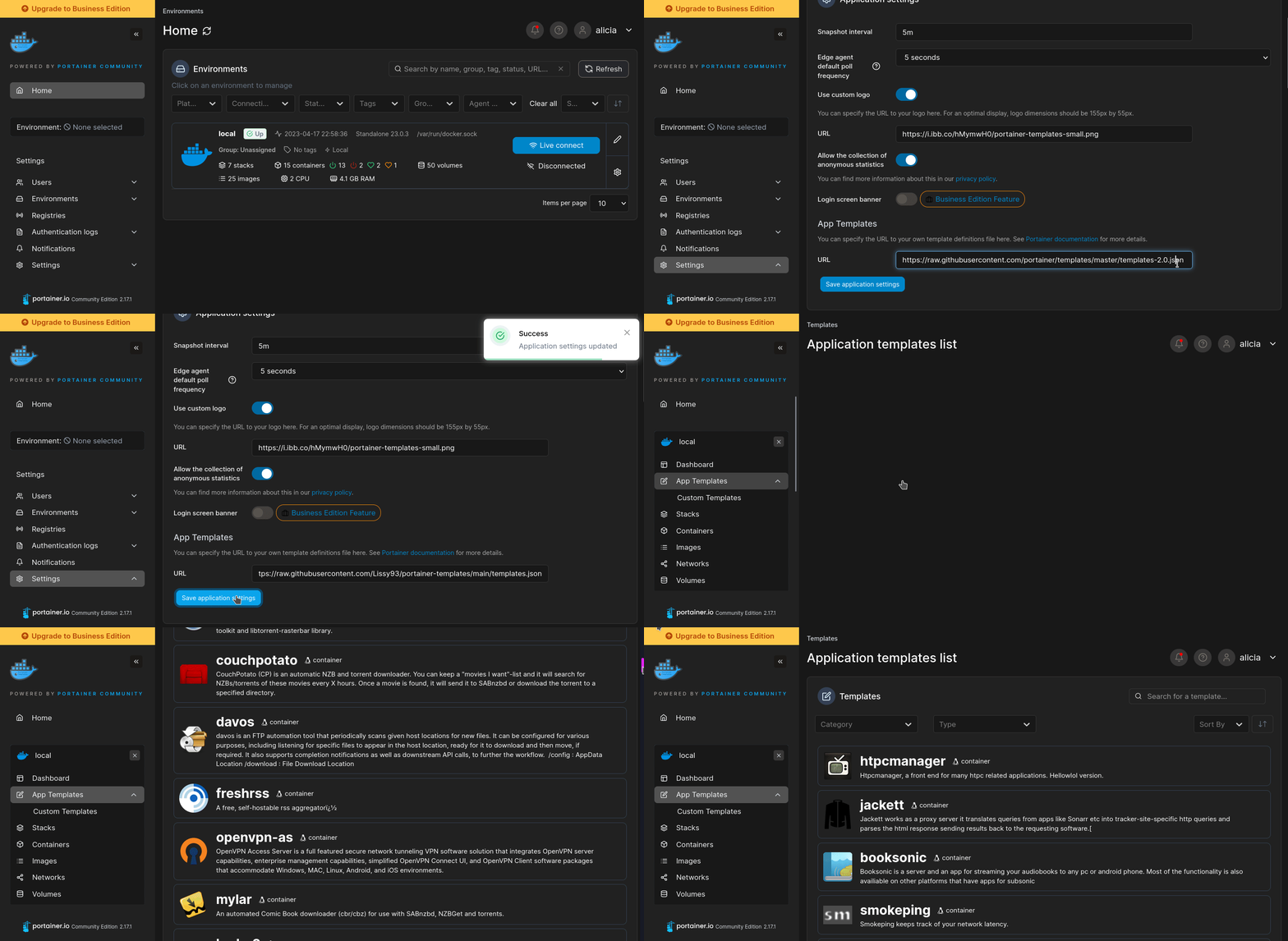
Import all app templates into your Portainer instance, for easy 1-click deploys
- Ensure both Docker and Portainer are installed, and up-to-date
- Log into your Portainer web UI
- Under Settings → App Templates, paste the below URL
- Head to Home → App Templates, and the list of apps will show up
- Select Let's Encrypt / SWAG, fill in any config options, and hit Deploy
Template Import URL
https://raw.githubusercontent.com/Lissy93/portainer-templates/main/templates.json
Show Me
More install options in our documentation.
linuxserver/swag
This readme has been truncated from the full version found HERE
SWAG - Secure Web Application Gateway (formerly known as letsencrypt, no relation to Let's Encrypt™) sets up an Nginx webserver and reverse proxy with php support and a built-in certbot client that automates free SSL server certificate generation and renewal processes (Let's Encrypt and ZeroSSL). It also contains fail2ban for intrusion prevention.Application Setup
Validation and initial setup
- Before running this container, make sure that the url and subdomains are properly forwarded to this container's host, and that port 443 (and/or 80) is not being used by another service on the host (NAS gui, another webserver, etc.).
- If you need a dynamic dns provider, you can use the free provider duckdns.org where the
URLwill beyoursubdomain.duckdns.organd theSUBDOMAINScan bewww,ftp,cloudwith http validation, orwildcardwith dns validation. You can use our duckdns image to update your IP on duckdns.org. - For
httpvalidation, port 80 on the internet side of the router should be forwarded to this container's port 80 - For
dnsvalidation, make sure to enter your credentials into the corresponding ini (or json for some plugins) file under/config/dns-conf
1. Certs that only cover your main subdomain (ie. `yoursubdomain.duckdns.org`, leave the `SUBDOMAINS` variable empty)
2. Certs that cover sub-subdomains of your main subdomain (ie. `*.yoursubdomain.duckdns.org`, set the `SUBDOMAINS` variable to `wildcard`)--cap-add=NET_ADMINis required for fail2ban to modify iptables- After setup, navigate to
https://example.comto access the default homepage (http access through port 80 is disabled by default, you can enable it by editing the default site config at/config/nginx/site-confs/default.conf). - Certs are checked twice daily using ACME Renewal Information (ARI) to determine the optimal renewal window. If your cert is about to expire, check the logs under
/config/log/letsencryptto see why the renewals have been failing.
Certbot Plugins
SWAG includes many Certbot plugins out of the box, but not all plugins can be included. If you need a plugin that is not included, the quickest way to have the plugin available is to use our Universal Package Install Docker Mod.Set the following environment variables on your container:
DOCKER_MODS=linuxserver/mods:universal-package-install
INSTALL_PIP_PACKAGES=certbot-dns-<plugin>
Set the required credentials (usually found in the plugin documentation) in
/config/dns-conf/<plugin>.ini.
It is recommended to attempt obtaining a certificate with STAGING=true first to make sure the plugin is working as expected.Security and password protection
- The container detects changes to url and subdomains, revokes existing certs and generates new ones during start.
- Per RFC7919, the container is shipping ffdhe4096 as the
dhparams.pem. - If you'd like to password protect your sites, you can use htpasswd. Run the following command on your host to generate the htpasswd file
docker exec -it swag htpasswd -c /config/nginx/.htpasswd <username> - You can add multiple user:pass to
.htpasswd. For the first user, use the above command, for others, use the above command without the-cflag, as it will force deletion of the existing.htpasswdand creation of a new one - You can also use ldap auth for security and access control. A sample, user configurable ldap.conf is provided, and it requires the separate image linuxserver/ldap-auth to communicate with an ldap server.
Site config and reverse proxy
- The default site config resides at
/config/nginx/site-confs/default.conf. Feel free to modify this file, and you can add other conf files to this directory. However, if you delete thedefaultfile, a new default will be created on container start. - Preset reverse proxy config files are added for popular apps. See the
README.mdfile under/config/nginx/proxy_confsfor instructions on how to enable them. The preset confs reside in and get imported from this repo. - If you wish to hide your site from search engine crawlers, you may find it useful to add this configuration line to your site config, within the server block, above the line where ssl.conf is included
add_header X-Robots-Tag "noindex, nofollow, nosnippet, noarchive";
This will ask Google et al not to index and list your site. Be careful with this, as you will eventually be de-listed if you leave this line in on a site you wish to be present on search engines- If you wish to redirect http to https, you must expose port 80
Using certs in other containers
- This container includes auto-generated pfx and private-fullchain-bundle pem certs that are needed by other apps like Emby and Znc.
-v /path-to-swag-config:/swag-ssl) and in the other containers, use the cert location /swag-ssl/keys/letsencrypt/
2. (More secure) Mount the SWAG folder etc that resides under /config in other containers (ie. -v /path-to-swag-config/etc:/swag-ssl) and in the other containers, use the cert location /swag-ssl/letsencrypt/live/<your.domain.url>/ (This is more secure because the first method shares the entire SWAG config folder with other containers, including the www files, whereas the second method only shares the ssl certs)
These certs include:
1. cert.pem, chain.pem, fullchain.pem and privkey.pem, which are generated by Certbot and used by nginx and various other apps
2. privkey.pfx, a format supported by Microsoft and commonly used by dotnet apps such as Emby Server (no password)
3. priv-fullchain-bundle.pem, a pem cert that bundles the private key and the fullchain, used by apps like ZNCUsing fail2ban
- This container includes fail2ban set up with 5 jails by default:
- To enable or disable other jails, modify the file
/config/fail2ban/jail.local - To modify filters and actions, instead of editing the
.conffiles, create.localfiles with the same name and edit those because .conf files get overwritten when the actions and filters are updated..localfiles will append whatever's in the.conffiles (ie.nginx-http-auth.conf-->nginx-http-auth.local) - You can check which jails are active via
docker exec -it swag fail2ban-client status - You can check the status of a specific jail via
docker exec -it swag fail2ban-client status <jail name> - You can unban an IP via
docker exec -it swag fail2ban-client set <jail name> unbanip <IP> - A list of commands for fail2ban-client can be found here
Updating configs
- This container creates a number of configs for nginx, proxy samples, etc.
- Config updates are noted in the changelog but not automatically applied to your files.
- If you have modified a file with noted changes in the changelog:
- If you have NOT modified a file with noted changes in the changelog:
- Proxy sample updates are not listed in the changelog. See the changes here: https://github.com/linuxserver/reverse-proxy-confs/commits/master
- Proxy sample files WILL be updated, however your renamed (enabled) proxy files will not.
- You can check the new sample and adjust your active config as needed.
QUIC support
This image supports QUIC (also known as HTTP/3) but it must be explicitly enabled in each proxy conf, and the default conf, because if the listener is enabled and you don't expose 443/UDP, it can break connections with some browsers.To enable QUIC, expose 443/UDP to your clients, then uncomment both QUIC listeners in all of your active proxy confs, as well as the default conf, and restart the container.
You should also uncomment the
Alt-Svc header in your ssl.conf so that browsers are aware that you offer QUIC connectivity.It is recommended to increase the UDP send/recieve buffer on the host by setting the
net.core.rmem_max and net.core.wmem_max sysctls. Suggested values are 4-16Mb (4194304-16777216 bytes). For persistence between reboots use /etc/sysctl.d/.Migration from the old linuxserver/letsencrypt image
Please follow the instructions on this blog post.Usage
docker run -d \
  --name=swag \
  --cap-add=NET_ADMIN \
  -e PUID=1000 \
  -e PGID=1000 \
  -e TZ=Etc/UTC \
  -e URL=example.com \
  -e VALIDATION=http \
  -e SUBDOMAINS=www, `#optional` \
  -e CERTPROVIDER= `#optional` \
  -e CERT_PROFILE= `#optional` \
  -e DNSPLUGIN=cloudflare `#optional` \
  -e PROPAGATION= `#optional` \
  -e EMAIL= `#optional` \
  -e ONLY_SUBDOMAINS=false `#optional` \
  -e EXTRA_DOMAINS= `#optional` \
  -e STAGING=false `#optional` \
  -e DISABLE_F2B= `#optional` \
  -e SWAG_AUTORELOAD= `#optional` \
  -e SWAG_AUTORELOAD_WATCHLIST= `#optional` \
  -p 443:443 \
  -p 80:80 `#optional` \
  -p 443:443/udp `#optional` \
  -v /path/to/swag/config:/config \
  --restart unless-stopped \
lscr.io/linuxserver/swag:latestServe Let's Encrypt / SWAG on your own domain behind Caddy, Nginx or Traefik. Fill in your domain and copy the result. It's a starting point, some apps need their own base URL or extra headers set too.
Proxying let-s-encrypt-swag.example.com to http://letsencrypt / SWAG:80
Add this to your Caddyfile
let-s-encrypt-swag.example.com {
	reverse_proxy http://letsencrypt / SWAG:80
}Check the logs first
Nine times out of ten the logs tell you exactly what went wrong.
- In Portainer, go to Containers, click the container, then Logs. Or run
docker logs letsencrypt / SWAG - Exit codes help too:
137means killed, usually out of memory.126or127means the command inside the image is broken.
Published on a random port
This template exposes 80/tcp without setting a host port,
so Docker picks a random free one on every deploy.
- Find it in the Ports column of Portainer's container list, or with
docker port letsencrypt / SWAG
Permission denied on volumes
If the logs show "permission denied", the app can't write to its data folder on the host.
- Fix the ownership:
sudo chown -R 1000:100 /portainer/Files/AppData/Config/LetsEncrypt - Or set the
PUIDandPGIDvariables (defaults 1000:100) to match your own user, found withid $USER
Image won't pull
Test the pull directly on the host: docker pull linuxserver/swag:latest
- "manifest unknown" means the tag no longer exists. This template uses
latest, so try pinning a specific version instead. - "toomanyrequests" is the Docker Hub rate limit. Log in with
docker loginto raise it. - "no space left on device" means a full disk. Reclaim space with
docker system prune
"exec format error"
This means the image was built for a different CPU architecture than your server.
- This image supports:
amd64, arm64 - Check yours with
uname -m: x86_64 is amd64, aarch64 is arm64. Raspberry Pi and other ARM boards are the usual culprits.
Container keeps restarting
The unless-stopped restart policy relaunches the app after every crash, so the real error can scroll past.
- Check the logs right after a restart, the last few lines before it died are the useful ones.
- Get the exit code with
docker inspect letsencrypt / SWAG --format '{{.State.ExitCode}}' - Still stuck? Redeploy once with the restart policy set to
noso the failure stays visible.
Raise an issue
Found something which isn't working as it should? Here's how to report it.
- Bug within the app: Open an issue within letsencrypt / SWAG's repo
- Template not working: Open an issue on xneo1/portainer_templates
- This website not working: Open an issue on lissy93/portainer-templates
A single container
Let's Encrypt / SWAG runs as one container, the simplest kind of app here. Just the one image to pull and nothing else wired up alongside it.
The app image
An image is the app packed up ready to go, everything Let's Encrypt / SWAG needs bundled into one download. This template pulls linuxserver/swag:latest, which Docker fetches once (about 151 MB) and then starts your own copy from.
Where the image comes from
Docker pulls its images from registries, public libraries of ready-built apps. Let's Encrypt / SWAG's comes from Docker Hub, published by linuxserver.
Version tags
The bit after the colon in the image name is the version tag. Here it's latest, which always points at the newest build, so a redeploy can bump you to a newer release without you asking. Newest right now is 5.8.0. Pin a specific tag if you would rather stay on one version.
Which machines it runs on
Every image is built for particular CPU types. This one ships for amd64, arm64, so it runs on both regular x86 servers and ARM boards like a Raspberry Pi.
Ports
A port is the door the app answers on. Here the app exposes a port but leaves the host side blank, so Docker picks a free one for you. It opens:
80, published on a random host port443, published on a random host port
Volumes
A volume is where Let's Encrypt / SWAG keeps its files so they survive an update or a restart. Without one, anything it saves would sit inside the container and vanish the moment it's recreated. This template mounts:
/configfrom/portainer/Files/AppData/Config/LetsEncrypton the host
Environment variables
Environment variables are the settings you hand over when you deploy, things like a password or a timezone. Let's Encrypt / SWAG takes 9 of them, all with defaults you can leave alone or tweak:
EMAIL, defaults to-Xms256m -Xmx512mURL, defaults to-Xms256m -Xmx512mSUBDOMAINS, defaults towww,ONLY_SUBDOMAINS, defaults tofalseDHLEVEL, defaults to2048PUID, defaults to1000PGID, defaults to100VALIDATION, defaults tohttpDNSPLUGIN, defaults tohttp
Restart policy
The restart policy here is unless-stopped, so Docker restarts Let's Encrypt / SWAG after a crash or reboot, but leaves it off when you stop it on purpose. You can change this on the deploy screen. The choices are no (never restart), on-failure (only after a crash), unless-stopped (restart unless you stop it), and always (bring it back no matter what).
Users and permissions
The PUID and PGID settings tell it which user and group to act as on your host. Point them at your own account (find yours with id $USER) so the files it writes into your mounted folders come out owned by you rather than root.
Networking
Nothing custom is set, so Let's Encrypt / SWAG sits on Docker's default bridge network: its own private space that reaches the outside world only through the ports it publishes.
Container name
Once it's deployed, Portainer names the container letsencrypt / SWAG. That's what you'll spot in the containers list and use in commands like docker logs letsencrypt / SWAG.
Platform
The platform is linux, the kind of system the container is built to run on. Docker and Portainer handle this on a normal Linux server.
Portainer app templates
Zooming out, this whole page comes from a Portainer app template: a short recipe telling Portainer how to set Let's Encrypt / SWAG up. Add the template list to Portainer once, then deploying Let's Encrypt / SWAG is a click rather than a wall of config.