
![RabbitMQ]() RabbitMQ
RabbitMQ
Container
Highly reliable enterprise messaging system
Image details
Configuration
TypeContainerlinuxrabbitmq:latest5671/tcp5672/tcp/var/lib/rabbitmqTemplate by portainer
Standalone Install
Select an install method, to see config/commands for deploying RabbitMQ
Install on Portainer
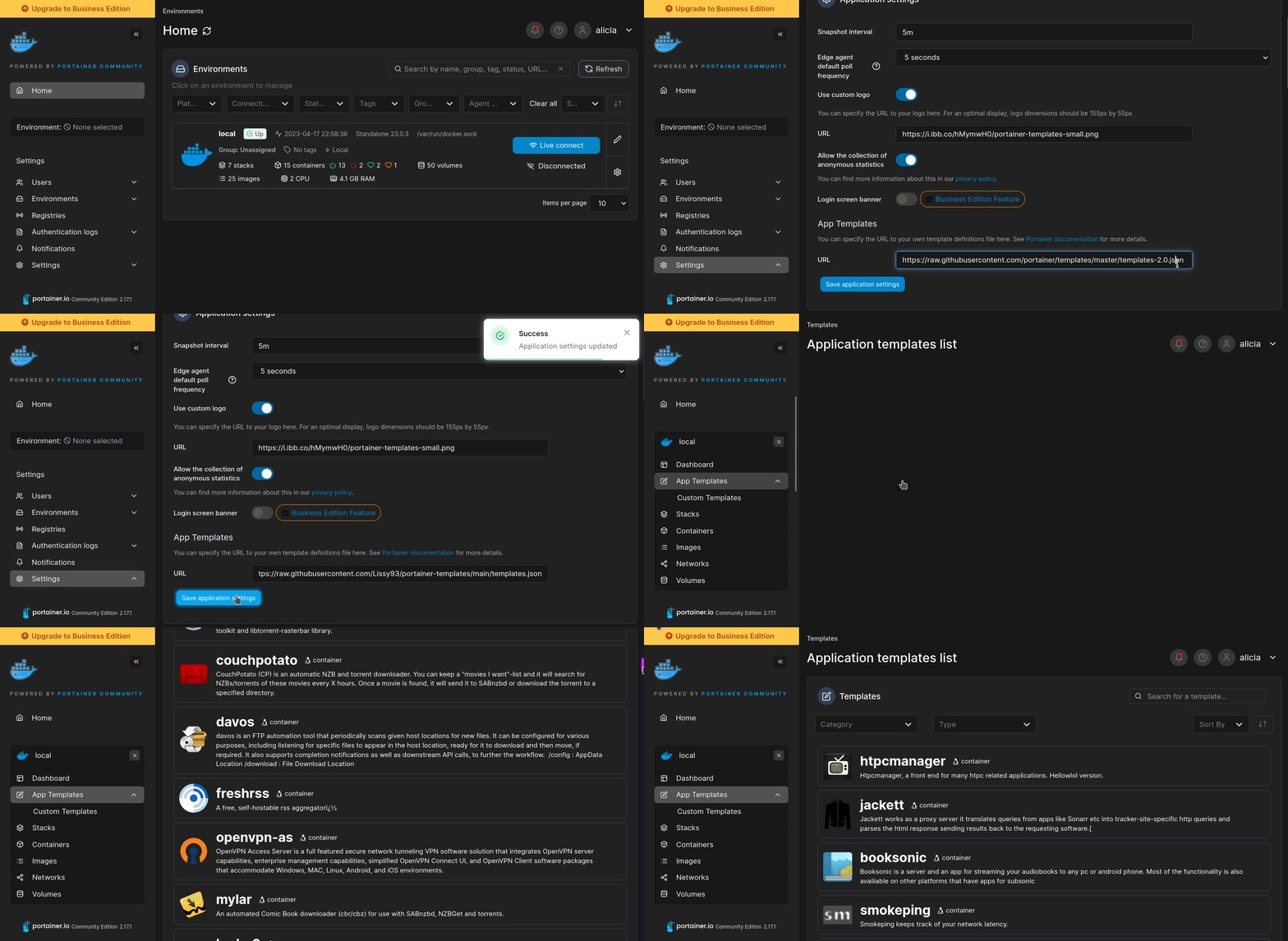
Import all app templates into your Portainer instance, for easy 1-click deploys
- Ensure both Docker and Portainer are installed, and up-to-date
- Log into your Portainer web UI
- Under Settings → App Templates, paste the below URL
- Head to Home → App Templates, and the list of apps will show up
- Select RabbitMQ, fill in any config options, and hit Deploy
Template Import URL
https://raw.githubusercontent.com/Lissy93/portainer-templates/main/templates.json
Show Me
More install options in our documentation.
Quick reference
- Maintained by:
[the Docker Community](https://github.com/docker-library/rabbitmq)- Where to get help:
[the Docker Community Slack](https://dockr.ly/comm-slack), [Server Fault](https://serverfault.com/help/on-topic), [Unix & Linux](https://unix.stackexchange.com/help/on-topic), or [Stack Overflow](https://stackoverflow.com/help/on-topic)Supported tags and respective Dockerfile links
Quick reference (cont.)
- Where to file issues:
[https://github.com/docker-library/rabbitmq/issues](https://github.com/docker-library/rabbitmq/issues?q=)- Supported architectures: (more info)
[`amd64`](https://hub.docker.com/r/amd64/rabbitmq/), [`arm32v6`](https://hub.docker.com/r/arm32v6/rabbitmq/), [`arm32v7`](https://hub.docker.com/r/arm32v7/rabbitmq/), [`arm64v8`](https://hub.docker.com/r/arm64v8/rabbitmq/), [`i386`](https://hub.docker.com/r/i386/rabbitmq/), [`ppc64le`](https://hub.docker.com/r/ppc64le/rabbitmq/), [`riscv64`](https://hub.docker.com/r/riscv64/rabbitmq/), [`s390x`](https://hub.docker.com/r/s390x/rabbitmq/)- Published image artifact details:
[repo-info repo's `repos/rabbitmq/` directory](https://github.com/docker-library/repo-info/blob/master/repos/rabbitmq) ([history](https://github.com/docker-library/repo-info/commits/master/repos/rabbitmq))
(image metadata, transfer size, etc)- Image updates:
[official-images repo's `library/rabbitmq` label](https://github.com/docker-library/official-images/issues?q=label%3Alibrary%2Frabbitmq)
[official-images repo's `library/rabbitmq` file](https://github.com/docker-library/official-images/blob/master/library/rabbitmq) ([history](https://github.com/docker-library/official-images/commits/master/library/rabbitmq))- Source of this description:
[docs repo's `rabbitmq/` directory](https://github.com/docker-library/docs/tree/master/rabbitmq) ([history](https://github.com/docker-library/docs/commits/master/rabbitmq))What is RabbitMQ?
RabbitMQ is open source message broker software (sometimes called message-oriented middleware) that implements the Advanced Message Queuing Protocol (AMQP). The RabbitMQ server is written in the Erlang programming language and is built on the Open Telecom Platform framework for clustering and failover. Client libraries to interface with the broker are available for all major programming languages.wikipedia.org/wiki/RabbitMQ

How to use this image
Running the daemon
One of the important things to note about RabbitMQ is that it stores data based on what it calls the "Node Name", which defaults to the hostname. What this means for usage in Docker is that we should specify-h/--hostname explicitly for each daemon so that we don't get a random hostname and can keep track of our data:$ docker run -d --hostname my-rabbit --name some-rabbit rabbitmq:3This will start a RabbitMQ container listening on the default port of 5672. If you give that a minute, then do
docker logs some-rabbit, you'll see in the output a block similar to:=INFO REPORT==== 6-Jul-2015::20:47:02 ===
node : rabbit@my-rabbit
home dir : /var/lib/rabbitmq
config file(s) : /etc/rabbitmq/rabbitmq.config
cookie hash : UoNOcDhfxW9uoZ92wh6BjA==
log : tty
sasl log : tty
database dir : /var/lib/rabbitmq/mnesia/rabbit@my-rabbitdatabase dir there, especially that it has my "Node Name" appended to the end for the file storage. This image makes all of /var/lib/rabbitmq a volume by default.Environment Variables
For a list of environment variables supported by RabbitMQ itself, see the Environment Variables section of rabbitmq.com/configureWARNING: As of RabbitMQ 3.9, all of the docker-specific variables listed below are deprecated and no longer used. Please use a configuration file instead; visit rabbitmq.com/configure to learn more about the configuration file. For a starting point, the 3.8 images will print out the config file it generated from supplied environment variables.
# Unavailable in 3.9 and up
RABBITMQ_DEFAULT_PASS_FILE
RABBITMQ_DEFAULT_USER_FILE
RABBITMQ_MANAGEMENT_SSL_CACERTFILE
RABBITMQ_MANAGEMENT_SSL_CERTFILE
RABBITMQ_MANAGEMENT_SSL_DEPTH
RABBITMQ_MANAGEMENT_SSL_FAIL_IF_NO_PEER_CERT
RABBITMQ_MANAGEMENT_SSL_KEYFILE
RABBITMQ_MANAGEMENT_SSL_VERIFY
RABBITMQ_SSL_CACERTFILE
RABBITMQ_SSL_CERTFILE
RABBITMQ_SSL_DEPTH
RABBITMQ_SSL_FAIL_IF_NO_PEER_CERT
RABBITMQ_SSL_KEYFILE
RABBITMQ_SSL_VERIFY
RABBITMQ_VM_MEMORY_HIGH_WATERMARK
Setting default user and password
If you wish to change the default username and password ofguest / guest, you can do so with the RABBITMQ_DEFAULT_USER and RABBITMQ_DEFAULT_PASS environmental variables. These variables were available previously in the docker-specific entrypoint shell script but are now available in RabbitMQ directly.$ docker run --detach --hostname my-rabbit --name some-rabbit \
--env RABBITMQ_DEFAULT_USER=user \
--env RABBITMQ_DEFAULT_PASS=password \
--publish 15672:15672 \
--publish 5672:5672 \
rabbitmq:managementYou can then go to
http://localhost:15672 or http://host-ip:15672 in a browser and use user/password to gain access to the management UI.Setting default vhost
If you wish to change the default vhost, you can do so with theRABBITMQ_DEFAULT_VHOST environmental variables:$ docker run -d --hostname my-rabbit --name some-rabbit -e RABBITMQ_DEFAULT_VHOST=my_vhost rabbitmq:3-managementMemory Limits
RabbitMQ contains functionality which explicitly tracks and manages memory usage, and thus needs to be made aware of cgroup-imposed limits (e.g.docker run --memory=..).The upstream configuration setting for this is
vm_memory_high_watermark in rabbitmq.conf, and it is described under "Memory Alarms" in the documentation. If you set a relative limit via vm_memory_high_watermark.relative, then RabbitMQ will calculate its limits based on the host's total memory and not the limit set by the contianer runtime.Erlang Cookie
See the RabbitMQ "Clustering Guide" for more information about cookies and why they're necessary. For setting a consistent cookie (especially useful for clustering but also for remote/cross-container administration viarabbitmqctl), provide a cookie file (default location of /var/lib/rabbitmq/.erlang.cookie).For example, you can provide the cookie via a file (such as with Docker Secrets):
docker service create ... --secret source=my-erlang-cookie,target=/var/lib/rabbitmq/.erlang.cookie ... rabbitmq(Note that it will likely also be necessary to specify
uid=XXX,gid=XXX,mode=0600 in order for Erlang in the container to be able to read the cookie file properly. See Docker's --secret documentation for more details.)Management Plugin
There is a second set of tags provided with the management plugin installed and enabled by default, which is available on the standard management port of 15672, with the default username and password ofguest / guest:$ docker run -d --hostname my-rabbit --name some-rabbit rabbitmq:3-managementYou can access it by visiting
http://container-ip:15672 in a browser or, if you need access outside the host, on port 8080:$ docker run -d --hostname my-rabbit --name some-rabbit -p 8080:15672 rabbitmq:3-managementYou can then go to
http://localhost:8080 or http://host-ip:8080 in a browser.Enabling Plugins
Creating a Dockerfile will have them enabled at runtime. To see the full list of plugins present on the imagerabbitmq-plugins listFROM rabbitmq:3.8-management
RUN rabbitmq-plugins enable --offline rabbitmq_mqtt rabbitmq_federation_management rabbitmq_stompYou can also mount a file at
/etc/rabbitmq/enabled_plugins with contents as an erlang list of atoms ending with a period.Example
enabled_plugins[rabbitmq_federation_management,rabbitmq_management,rabbitmq_mqtt,rabbitmq_stomp].Additional Configuration
If configuration is required, it is recommended to supply an appropriate/etc/rabbitmq/rabbitmq.conf file (see the "Configuration File(s)" section of the RabbitMQ documentation for more details), for example via bind-mount, Docker Configs, or a short Dockerfile with a COPY instruction.Alternatively, it is possible to use the
RABBITMQ_SERVER_ADDITIONAL_ERL_ARGS environment variable, whose syntax is described in section 7.8 ("Configuring an Application") of the Erlang OTP Design Principles User's Guide (the appropriate value for -ApplName is -rabbit), this method requires a slightly different reproduction of its equivalent entry in rabbitmq.conf. For example, configuring channel_max would look something like -e RABBITMQ_SERVER_ADDITIONAL_ERL_ARGS="-rabbit channel_max 4007". Where the space between the variable channel_max and its value 4007 correctly becomes a comma when translated in the environment.Health/Liveness/Readiness Checking
See the "Official Images" FAQ and the discussion on docker-library/rabbitmq#174 (especially the large comment by Michael Klishin from RabbitMQ upstream) for a detailed explanation of why this image does not come with a defaultHEALTHCHECK defined, and for suggestions for implementing your own health/liveness/readiness checks.Image Variants
Therabbitmq images come in many flavors, each designed for a specific use case.rabbitmq:<version>
This is the defacto image. If you are unsure about what your needs are, you probably want to use this one. It is designed to be used both as a throw away container (mount your source code and start the container to start your app), as well as the base to build other images off of.rabbitmq:<version>-alpine
This image is based on the popular Alpine Linux project, available in the alpine official image. Alpine Linux is much smaller than most distribution base images (~5MB), and thus leads to much slimmer images in general.This variant is useful when final image size being as small as possible is your primary concern. The main caveat to note is that it does use musl libc instead of glibc and friends, so software will often run into issues depending on the depth of their libc requirements/assumptions. See this Hacker News comment thread for more discussion of the issues that might arise and some pro/con comparisons of using Alpine-based images.
To minimize image size, it's uncommon for additional related tools (such as
git or bash) to be included in Alpine-based images. Using this image as a base, add the things you need in your own Dockerfile (see the alpine image description for examples of how to install packages if you are unfamiliar).License
View license information for the software contained in this image.As with all Docker images, these likely also contain other software which may be under other licenses (such as Bash, etc from the base distribution, along with any direct or indirect dependencies of the primary software being contained).
Some additional license information which was able to be auto-detected might be found in the
repo-info repository's rabbitmq/ directory.As for any pre-built image usage, it is the image user's responsibility to ensure that any use of this image complies with any relevant licenses for all software contained within.
Serve RabbitMQ on your own domain behind Caddy, Nginx or Traefik. Fill in your domain and copy the result. It's a starting point, some apps need their own base URL or extra headers set too.
Proxying rabbitmq.example.com to http://rabbitmq:5671
Add this to your Caddyfile
rabbitmq.example.com {
	reverse_proxy http://rabbitmq:5671
}Check the logs first
Nine times out of ten the logs tell you exactly what went wrong.
- In Portainer, go to Containers, click the container, then Logs. Or run
docker logs <container> - Exit codes help too:
137means killed, usually out of memory.126or127means the command inside the image is broken.
Published on a random port
This template exposes 5671/tcp without setting a host port,
so Docker picks a random free one on every deploy.
- Find it in the Ports column of Portainer's container list, or with
docker port <container>
Image won't pull
Test the pull directly on the host: docker pull rabbitmq:latest
- "manifest unknown" means the tag no longer exists. This template uses
latest, so try pinning a specific version instead. - "toomanyrequests" is the Docker Hub rate limit. Log in with
docker loginto raise it. - "no space left on device" means a full disk. Reclaim space with
docker system prune
"exec format error"
This means the image was built for a different CPU architecture than your server.
- This image supports:
amd64, arm/v7, arm/v6, 386, ppc64le, s390x, riscv64, arm64/v8 - Check yours with
uname -m: x86_64 is amd64, aarch64 is arm64. Raspberry Pi and other ARM boards are the usual culprits.
Raise an issue
Found something which isn't working as it should? Here's how to report it.
- Bug within the app: Open an issue within the app's repo
- Template not working: Open an issue on portainer/templates
- This website not working: Open an issue on lissy93/portainer-templates
A single container
RabbitMQ runs as one container, the simplest kind of app here. Just the one image to pull and nothing else wired up alongside it.
The app image
An image is the app packed up ready to go, everything RabbitMQ needs bundled into one download. This template pulls rabbitmq:latest, which Docker fetches once (about 108 MB) and then starts your own copy from.
Where the image comes from
Docker pulls its images from registries, public libraries of ready-built apps. RabbitMQ's comes from Docker Hub as one of its official, curated images.
Version tags
The bit after the colon in the image name is the version tag. Here it's latest, which always points at the newest build, so a redeploy can bump you to a newer release without you asking. Newest right now is 4.0.9-management. Pin a specific tag if you would rather stay on one version.
Which machines it runs on
Every image is built for particular CPU types. This one ships for amd64, arm/v7, arm/v6, 386, ppc64le, s390x, riscv64, arm64/v8, so it runs on both regular x86 servers and ARM boards like a Raspberry Pi.
Ports
A port is the door the app answers on. Here the app exposes a port but leaves the host side blank, so Docker picks a free one for you. It opens:
5671, published on a random host port5672, published on a random host port
Volumes
A volume is where RabbitMQ keeps its files so they survive an update or a restart. Without one, anything it saves would sit inside the container and vanish the moment it's recreated. This template mounts:
/var/lib/rabbitmqas a volume Docker manages for you
Networking
Nothing custom is set, so RabbitMQ sits on Docker's default bridge network: its own private space that reaches the outside world only through the ports it publishes.
Platform
The platform is linux, the kind of system the container is built to run on. Docker and Portainer handle this on a normal Linux server.
Portainer app templates
Zooming out, this whole page comes from a Portainer app template: a short recipe telling Portainer how to set RabbitMQ up. Add the template list to Portainer once, then deploying RabbitMQ is a click rather than a wall of config.