
![Transmission OpenVPN v3]() Transmission OpenVPN v3
Transmission OpenVPN v3
Container
This container contains OpenVPN and Transmission with a configuration where Transmission is running only when OpenVPN has an active tunnel. It bundles configuration files for many popular VPN providers to make the setup easier.
Image details
Source details
Configuration
TypeContainerlinuxhaugene/transmission-openvpn:3.7.1Yes9091:9091/tcp/config : /portainer/Files/AppData/Config/transmission-openvpn/data : /portainer/Downloads/etc/localtime : /etc/localtimePUID=1000PGID=1000OPENVPN_PROVIDER=MULLVADOPENVPN_CONFIG=OPENVPN_USERNAME=OPENVPN_PASSWORD=LOCAL_NETWORK=192.168.0.0/24TRANSMISSION_WATCH_DIR_ENABLED=trueunless-stoppedTemplate by novaspirit
Report issueNotes
Check our Github page: https://github.com/pi-hosted/pi-hosted
Official Webpage: https://transmissionbt.com/
Official Docker Documentation: https://haugene.github.io/docker-transmission-openvpn/run-container/
Youtube Video: Novaspirit Tech - Torrent with Docker and OPENVPN with Transmission and PIA
List of supported providers available here.
Standalone Install
Select an install method, to see config/commands for deploying Transmission OpenVPN v3
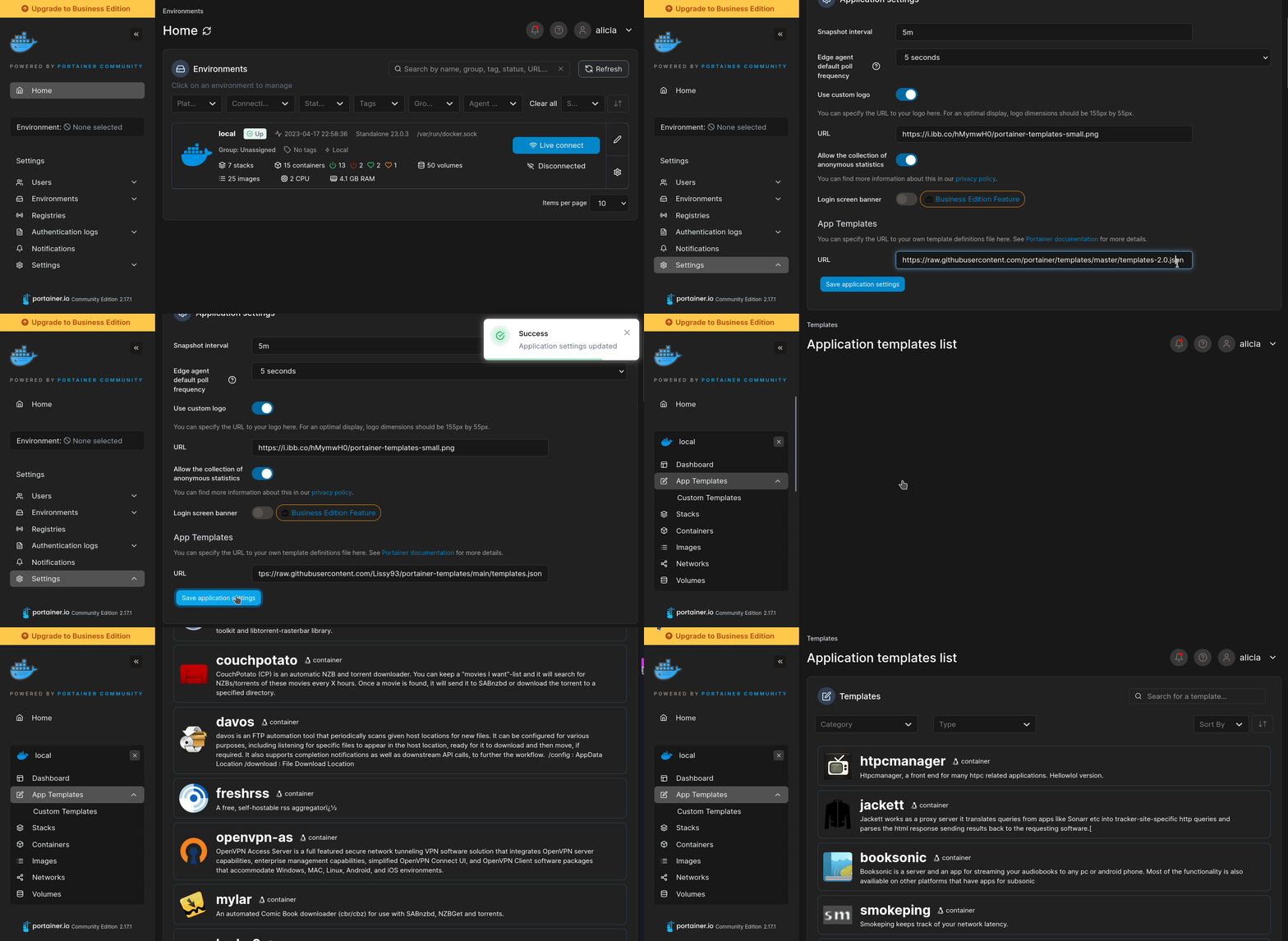
Install on Portainer
Import all app templates into your Portainer instance, for easy 1-click deploys
- Ensure both Docker and Portainer are installed, and up-to-date
- Log into your Portainer web UI
- Under Settings → App Templates, paste the below URL
- Head to Home → App Templates, and the list of apps will show up
- Select Transmission OpenVPN v3, fill in any config options, and hit Deploy
Template Import URL
https://raw.githubusercontent.com/Lissy93/portainer-templates/main/templates.json
Show Me
More install options in our documentation, or see haugene/docker-transmission-openvpn for app-specific guidance.
OpenVPN and Transmission with WebUI


This container contains OpenVPN and Transmission with a configuration where Transmission is running only when OpenVPN has an active tunnel. It has built-in support for many popular VPN providers to make the setup easier.
Read this first
The documentation for this image is hosted on GitHub pages:https://haugene.github.io/docker-transmission-openvpn/
If you can't find what you're looking for there, please have a look in the discussions as we're trying to use that for general questions.
If you have found what you believe to be an issue or bug, create an issue and provide enough details for us to have a chance to reproduce it or understand what's going on. NB: Be sure to search for similar issues (open and closed) before opening a new one.
Quick Start
These examples show valid setups using PIA as the provider for both docker run and docker-compose. Note that you should read some documentation at some point, but this is a good place to start.Docker run
$ docker run --cap-add=NET_ADMIN -d \
              -v /your/storage/path/:/data \
              -v /your/config/path/:/config \
              -e OPENVPN_PROVIDER=PIA \
              -e OPENVPN_CONFIG=france \
              -e OPENVPN_USERNAME=user \
              -e OPENVPN_PASSWORD=pass \
              -e LOCAL_NETWORK=192.168.0.0/16 \
              --log-driver json-file \
              --log-opt max-size=10m \
              -p 9091:9091 \
              haugene/transmission-openvpn
Podman run
Beware: container is run as privileged, meaning it has full access to host OS.$ podman run --privileged -d \
-v /your/storage/path/:/data \
-v /your/config/path/:/config \
-e OPENVPN_PROVIDER=PIA \
-e OPENVPN_CONFIG=france \
-e OPENVPN_USERNAME=user \
-e OPENVPN_PASSWORD=pass \
-e LOCAL_NETWORK=192.168.0.0/16 \
--log-driver k8s-file \
--log-opt max-size=10m \
-p 9091:9091 \
haugene/transmission-openvpnDocker version 3.x Compose
version: '3.3'
services:
    transmission-openvpn:
        cap_add:
            - NET_ADMIN
        volumes:
            - '/your/storage/path/:/data'
            - '/your/config/path/:/config'
        environment:
            - OPENVPN_PROVIDER=PIA
            - OPENVPN_CONFIG=france
            - OPENVPN_USERNAME=user
            - OPENVPN_PASSWORD=pass
            - LOCAL_NETWORK=192.168.0.0/16
        logging:
            driver: json-file
            options:
                max-size: 10m
        ports:
            - '9091:9091'
        image: haugene/transmission-openvpn
Docker version 2.x Compose
version: "2.0"
services:
    transmission-openvpn:
        container_name: transmission
        cap_add:
            - NET_ADMIN
        volumes:
            - '/your/storage/path/:/data'
            - '/your/config/path/:/config'
        environment:
            - OPENVPN_PROVIDER=PIA
            - OPENVPN_CONFIG=france
            - OPENVPN_USERNAME=user
            - OPENVPN_PASSWORD=pass
            - LOCAL_NETWORK=192.168.0.0/16
        logging:
            driver: "json-file"
            options:
                max-size: 10m
        ports:
            - 9091:9091
        image: haugene/transmission-openvpn
Known issues
If you've been running a stable setup that has recently started to fail, please check your logs. Are you seeingcurl: (6) getaddrinfo() thread failed to start or WARNING: initial DNS resolution test failed?
Then have a look at #2410
and this comment
in particular. There is a fix and a workaround available.Image versioning
We aim to create periodic fixed releases with a semver versioning scheme. The latest of the tagged fixed releases will also have thelatest tag.A semver release will be tagged with
major, major.minor and major.minor.patch versions so that you can lock
the version at either level.We also have a tag called
edge which will always be the latest commit on master, and dev which is the last commit on the dev branch.
From time to time we can also have various beta branches and tags, but using either dev or beta tags is probably not for the average user
and you should expect there to be occasional breakage or even the deletion of the tags upstream.Please help out (about:maintenance)
This image was created for my own use, but sharing is caring, so it had to be open source. It has now gotten quite popular, and that's great! But keeping it up to date, providing support, fixes and new features take time. If you feel that you're getting a good tool and want to support it, there are a couple of options:A small montly amount through
 or
a one time donation with
or
a one time donation with 
All donations are greatly appreciated! Another great way to contribute is of course through code. A big thanks to everyone who has contributed so far!
Serve Transmission OpenVPN v3 on your own domain behind Caddy, Nginx or Traefik. Fill in your domain and copy the result. It's a starting point, some apps need their own base URL or extra headers set too.
Proxying transmission-openvpn-v3.example.com to http://transmission-openvpn:9091
Add this to your Caddyfile
transmission-openvpn-v3.example.com {
	reverse_proxy http://transmission-openvpn:9091
}Check the logs first
Nine times out of ten the logs tell you exactly what went wrong.
- In Portainer, go to Containers, click the container, then Logs. Or run
docker logs transmission-openvpn - Exit codes help too:
137means killed, usually out of memory.126or127means the command inside the image is broken.
Port already in use
If deployment fails with "Bind for 0.0.0.0:9091 failed: port is already allocated", something else on your server is using that port.
- Find what's using it:
sudo ss -tlnp | grep :9091 - Stop the other service, or pick a different host port. In
9091:9091only the left number is yours to change, the right one belongs to the app.
Running but the page won't load
The container is up but nothing appears in your browser.
- Use your server's real IP:
http://your-server-ip:9091. The 0.0.0.0 link Portainer shows isn't a real address. - Give it a minute after first deploy, transmission-openvpn can take a while to initialise.
- Make sure your firewall allows the port, e.g.
sudo ufw allow 9091
Permission denied on volumes
If the logs show "permission denied", the app can't write to its data folder on the host.
- Fix the ownership:
sudo chown -R 1000:1000 /portainer/Files/AppData/Config/transmission-openvpn(and the same for the other mapped folders) - Or set the
PUIDandPGIDvariables (defaults 1000:1000) to match your own user, found withid $USER
Image won't pull
Test the pull directly on the host: docker pull haugene/transmission-openvpn:3.7.1
- "manifest unknown" means the tag no longer exists.
- "toomanyrequests" is the Docker Hub rate limit. Log in with
docker loginto raise it. - "no space left on device" means a full disk. Reclaim space with
docker system prune
"exec format error"
This means the image was built for a different CPU architecture than your server.
- This image supports:
amd64, arm64, arm/v7 - Check yours with
uname -m: x86_64 is amd64, aarch64 is arm64. Raspberry Pi and other ARM boards are the usual culprits.
Container keeps restarting
The unless-stopped restart policy relaunches the app after every crash, so the real error can scroll past.
- Check the logs right after a restart, the last few lines before it died are the useful ones.
- Get the exit code with
docker inspect transmission-openvpn --format '{{.State.ExitCode}}' - Still stuck? Redeploy once with the restart policy set to
noso the failure stays visible.
Required settings are blank
OPENVPN_CONFIG, OPENVPN_USERNAME, OPENVPN_PASSWORD have no default value, and transmission-openvpn may crash or misbehave if left empty.
- Fill them in on the deploy screen before hitting deploy.
Privileged mode
This template runs the container in privileged mode, giving it full access to your host.
- Only deploy it if you trust the app.
- If deployment is blocked, your Portainer security settings or hardened host may not allow privileged containers.
Raise an issue
Found something which isn't working as it should? Here's how to report it.
- Bug within the app: Open an issue on haugene/docker-transmission-openvpn
- Template not working: Open an issue on novaspirit/pi-hosted
- This website not working: Open an issue on lissy93/portainer-templates
A single container
Transmission OpenVPN v3 runs as one container, the simplest kind of app here. Just the one image to pull and nothing else wired up alongside it.
The app image
An image is the app packed up ready to go, everything Transmission OpenVPN v3 needs bundled into one download. This template pulls haugene/transmission-openvpn:3.7.1, which Docker fetches once (about 116 MB) and then starts your own copy from.
Where the image comes from
Docker pulls its images from registries, public libraries of ready-built apps. Transmission OpenVPN v3's comes from Docker Hub, published by haugene.
Version tags
The bit after the colon in the image name is the version tag. This one pins 3.7.1, so every redeploy gives you that exact build until you bump it yourself.
Which machines it runs on
Every image is built for particular CPU types. This one ships for amd64, arm64, arm/v7, so it runs on both regular x86 servers and ARM boards like a Raspberry Pi.
Ports
A port is the door the app answers on. A mapping like 9091:9091 means it's reachable on port 9091 of your server, where the left number is yours to change and the right one belongs to the app. It opens:
9091:9091
Volumes
A volume is where Transmission OpenVPN v3 keeps its files so they survive an update or a restart. Without one, anything it saves would sit inside the container and vanish the moment it's recreated. This template mounts:
/configfrom/portainer/Files/AppData/Config/transmission-openvpnon the host/datafrom/portainer/Downloadson the host/etc/localtimefrom/etc/localtimeon the host
Environment variables
Environment variables are the settings you hand over when you deploy, things like a password or a timezone. Transmission OpenVPN v3 takes 8 of them, and 3 need a value before it'll start properly:
PUID, defaults to1000PGID, defaults to1000OPENVPN_PROVIDER, defaults toMULLVAD. Https://haugene.github.io/docker-transmission-openvpn/supported-providers/OPENVPN_CONFIG, needs a value. Optional. Mostly used to narrow down what location to use by the providerOPENVPN_USERNAME, needs a valueOPENVPN_PASSWORD, needs a valueLOCAL_NETWORK, defaults to192.168.0.0/24TRANSMISSION_WATCH_DIR_ENABLED, defaults totrue. Watch-dir-enabled
Restart policy
The restart policy here is unless-stopped, so Docker restarts Transmission OpenVPN v3 after a crash or reboot, but leaves it off when you stop it on purpose. You can change this on the deploy screen. The choices are no (never restart), on-failure (only after a crash), unless-stopped (restart unless you stop it), and always (bring it back no matter what).
Users and permissions
The PUID and PGID settings tell it which user and group to act as on your host. Point them at your own account (find yours with id $USER) so the files it writes into your mounted folders come out owned by you rather than root.
Networking
Nothing custom is set, so Transmission OpenVPN v3 sits on Docker's default bridge network: its own private space that reaches the outside world only through the ports it publishes.
Container name
Once it's deployed, Portainer names the container transmission-openvpn. That's what you'll spot in the containers list and use in commands like docker logs transmission-openvpn.
Privileged mode
This template runs Transmission OpenVPN v3 in privileged mode, which gives it nearly as much access to your server as the system itself. Some apps genuinely need it to reach hardware or manage the host, so it's one to run only if you trust the source.
Platform
The platform is linux, the kind of system the container is built to run on. Docker and Portainer handle this on a normal Linux server.
Open source license
Transmission OpenVPN v3 is open source, released under the GPL-3.0 license. In plain terms the code is out in the open, so you're free to run it and change it to fit what you need.
Portainer app templates
Zooming out, this whole page comes from a Portainer app template: a short recipe telling Portainer how to set Transmission OpenVPN v3 up. Add the template list to Portainer once, then deploying Transmission OpenVPN v3 is a click rather than a wall of config.