
![Ubuntu]() Ubuntu
Ubuntu
Container
Debian-based Linux operating system
Image details
Configuration
TypeContainerlinuxubuntu:latest/bin/bashYesTemplate by portainer
Report issueStandalone Install
Select an install method, to see config/commands for deploying Ubuntu
Install on Portainer
Import all app templates into your Portainer instance, for easy 1-click deploys
- Ensure both Docker and Portainer are installed, and up-to-date
- Log into your Portainer web UI
- Under Settings → App Templates, paste the below URL
- Head to Home → App Templates, and the list of apps will show up
- Select Ubuntu, fill in any config options, and hit Deploy
Template Import URL
https://raw.githubusercontent.com/Lissy93/portainer-templates/main/templates.json
Show Me
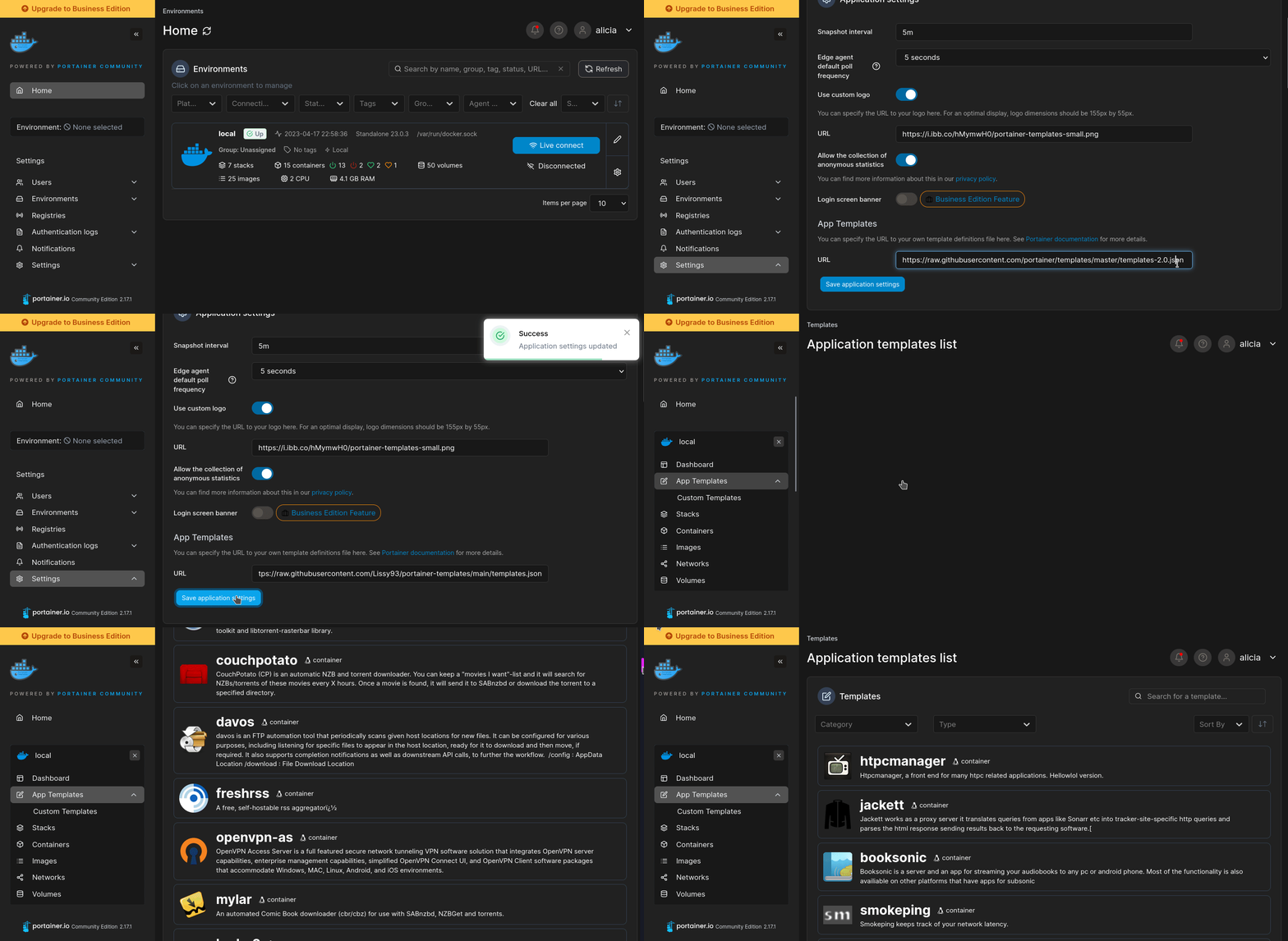
More install options in our documentation.
Quick reference
- Maintained by:
[Canonical](https://launchpad.net/cloud-images)- Where to get help:
[the Docker Community Slack](https://dockr.ly/comm-slack), [Server Fault](https://serverfault.com/help/on-topic), [Unix & Linux](https://unix.stackexchange.com/help/on-topic), or [Stack Overflow](https://stackoverflow.com/help/on-topic)Supported tags and respective Dockerfile links
Quick reference (cont.)
- Where to file issues:
[the cloud-images bug tracker](https://bugs.launchpad.net/cloud-images) (include the `docker` tag)- Supported architectures: (more info)
[`amd64`](https://hub.docker.com/r/amd64/ubuntu/), [`arm32v7`](https://hub.docker.com/r/arm32v7/ubuntu/), [`arm64v8`](https://hub.docker.com/r/arm64v8/ubuntu/), [`ppc64le`](https://hub.docker.com/r/ppc64le/ubuntu/), [`riscv64`](https://hub.docker.com/r/riscv64/ubuntu/), [`s390x`](https://hub.docker.com/r/s390x/ubuntu/)- Published image artifact details:
[repo-info repo's `repos/ubuntu/` directory](https://github.com/docker-library/repo-info/blob/master/repos/ubuntu) ([history](https://github.com/docker-library/repo-info/commits/master/repos/ubuntu))
(image metadata, transfer size, etc)- Image updates:
[official-images repo's `library/ubuntu` label](https://github.com/docker-library/official-images/issues?q=label%3Alibrary%2Fubuntu)
[official-images repo's `library/ubuntu` file](https://github.com/docker-library/official-images/blob/master/library/ubuntu) ([history](https://github.com/docker-library/official-images/commits/master/library/ubuntu))- Source of this description:
[docs repo's `ubuntu/` directory](https://github.com/docker-library/docs/tree/master/ubuntu) ([history](https://github.com/docker-library/docs/commits/master/ubuntu))What is Ubuntu?
Ubuntu is a Debian-based Linux operating system that runs from the desktop to the cloud, to all your internet connected things. It is the world's most popular operating system across public clouds and OpenStack clouds. It is the number one platform for containers; from Docker to Kubernetes to LXD, Ubuntu can run your containers at scale. Fast, secure and simple, Ubuntu powers millions of PCs worldwide.Development of Ubuntu is led by Canonical Ltd. Canonical generates revenue through the sale of technical support and other services related to Ubuntu. The Ubuntu project is publicly committed to the principles of open-source software development; people are encouraged to use free software, study how it works, improve upon it, and distribute it.
ubuntu.com

What's in this image?
This image is built from official rootfs tarballs provided by Canonical (seedist-* tags at https://git.launchpad.net/cloud-images/+oci/ubuntu-base).The
ubuntu:latest tag points to the "latest LTS", since that's the version recommended for general use. The ubuntu:rolling tag points to the latest release (regardless of LTS status).Along a similar vein, the
ubuntu:devel tag is an alias for whichever release the "devel" suite on the mirrors currently points to, as determined by the following one-liner: wget -qO- http://archive.ubuntu.com/ubuntu/dists/devel/Release | awk -F ': ' '$1 == "Codename" { print $2; exit }'Locales
Given that it is a minimal install of Ubuntu, this image only includes theC, C.UTF-8, and POSIX locales by default. For most uses requiring a UTF-8 locale, C.UTF-8 is likely sufficient (-e LANG=C.UTF-8 or ENV LANG C.UTF-8).For uses where that is not sufficient, other locales can be installed/generated via the
locales package. PostgreSQL has a good example of doing so, copied below:RUN apt-get update && apt-get install -y locales && rm -rf /var/lib/apt/lists/* \
&& localedef -i en_US -c -f UTF-8 -A /usr/share/locale/locale.alias en_US.UTF-8
ENV LANG en_US.utf8Unminimize
Starting from Ubuntu 24.10 "Oracular Oriole", theunminimize command will no longer be shipped by default on minimal images. It has now been moved to a dedicated package which can be installed via apt-get install -y unminimize.How is the rootfs built?
Ubuntu 25.10 "Questing Quokka" and earlier
The tarballs published by Canonical, referenced bydist-* tags in https://git.launchpad.net/cloud-images/+oci/ubuntu-base Git repository, are built from scripts that live in the livecd-rootfs project, especially live-build/auto/build. The builds are run on Launchpad. For build history see livefs build pages of individual releases on Launchpad:Ubuntu 26.04 LTS "Resolute Raccoon" and later
Starting from Ubuntu 26.04 LTS, the rootfs is no longer built vialivefs. Instead, the image is built directly with Rockcraft from the recipe on the main branch of the same ubuntu-base repo, and the rootfs tarballs under the <codename>-<release> tags of the ubuntu-base repo are exported from the Rockcraft build artifacts.License
View license information for the software contained in this image.As with all Docker images, these likely also contain other software which may be under other licenses (such as Bash, etc from the base distribution, along with any direct or indirect dependencies of the primary software being contained).
Some additional license information which was able to be auto-detected might be found in the
repo-info repository's ubuntu/ directory.As for any pre-built image usage, it is the image user's responsibility to ensure that any use of this image complies with any relevant licenses for all software contained within.
Check the logs first
Nine times out of ten the logs tell you exactly what went wrong.
- In Portainer, go to Containers, click the container, then Logs. Or run
docker logs <container> - Exit codes help too:
137means killed, usually out of memory.126or127means the command inside the image is broken.
Image won't pull
Test the pull directly on the host: docker pull ubuntu:latest
- "manifest unknown" means the tag no longer exists. This template uses
latest, so try pinning a specific version instead. - "toomanyrequests" is the Docker Hub rate limit. Log in with
docker loginto raise it. - "no space left on device" means a full disk. Reclaim space with
docker system prune
"exec format error"
This means the image was built for a different CPU architecture than your server.
- This image supports:
amd64, arm64, arm/v7, ppc64le, s390x, riscv64, arm, arm64/v8 - Check yours with
uname -m: x86_64 is amd64, aarch64 is arm64. Raspberry Pi and other ARM boards are the usual culprits.
Data disappears when the container is recreated
This template doesn't define any volumes, so everything the app saves lives inside the container and is lost on update or recreate.
- Add a volume mapping for the app's data folder before storing anything you care about.
Raise an issue
Found something which isn't working as it should? Here's how to report it.
- Bug within the app: Open an issue within the app's repo
- Template not working: Open an issue on portainer/templates
- This website not working: Open an issue on lissy93/portainer-templates
A single container
Ubuntu runs as one container, the simplest kind of app here. Just the one image to pull and nothing else wired up alongside it.
The app image
An image is the app packed up ready to go, everything Ubuntu needs bundled into one download. This template pulls ubuntu:latest, which Docker fetches once (about 43 MB) and then starts your own copy from.
Where the image comes from
Docker pulls its images from registries, public libraries of ready-built apps. Ubuntu's comes from Docker Hub as one of its official, curated images.
Version tags
The bit after the colon in the image name is the version tag. Here it's latest, which always points at the newest build, so a redeploy can bump you to a newer release without you asking. Newest right now is 26.10. Pin a specific tag if you would rather stay on one version.
Which machines it runs on
Every image is built for particular CPU types. This one ships for amd64, arm64, arm/v7, ppc64le, s390x, riscv64, arm, arm64/v8, so it runs on both regular x86 servers and ARM boards like a Raspberry Pi.
No stored data
This template doesn't mount any storage, so whatever Ubuntu writes stays inside the container and is wiped if it's recreated or updated. That's fine for something stateless, but add a volume before trusting it with anything you want to keep.
Networking
Nothing custom is set, so Ubuntu sits on Docker's default bridge network: its own private space that reaches the outside world only through the ports it publishes.
Startup command
The command is what runs the moment the container starts. This template sets its own, /bin/bash, in place of the image's default.
Interactive mode
This one's built to be used interactively, so it keeps a terminal open for you to type into instead of quietly ticking along in the background.
Platform
The platform is linux, the kind of system the container is built to run on. Docker and Portainer handle this on a normal Linux server.
Portainer app templates
Zooming out, this whole page comes from a Portainer app template: a short recipe telling Portainer how to set Ubuntu up. Add the template list to Portainer once, then deploying Ubuntu is a click rather than a wall of config.