
![PairDrop]() PairDrop
PairDrop
Container
Local file sharing in your browser, inspired by Apple's AirDrop. Source: https://github.com/schlagmichdoch/PairDrop
Source details
Configuration
TypeContainerlinuxlscr.io/linuxserver/pairdrop:latest3000:3000/tcpPUID=1000PGID=1000TZ=Etc/UTCunless-stoppedStandalone Install
Select an install method, to see config/commands for deploying PairDrop
Install on Portainer
Import all app templates into your Portainer instance, for easy 1-click deploys
- Ensure both Docker and Portainer are installed, and up-to-date
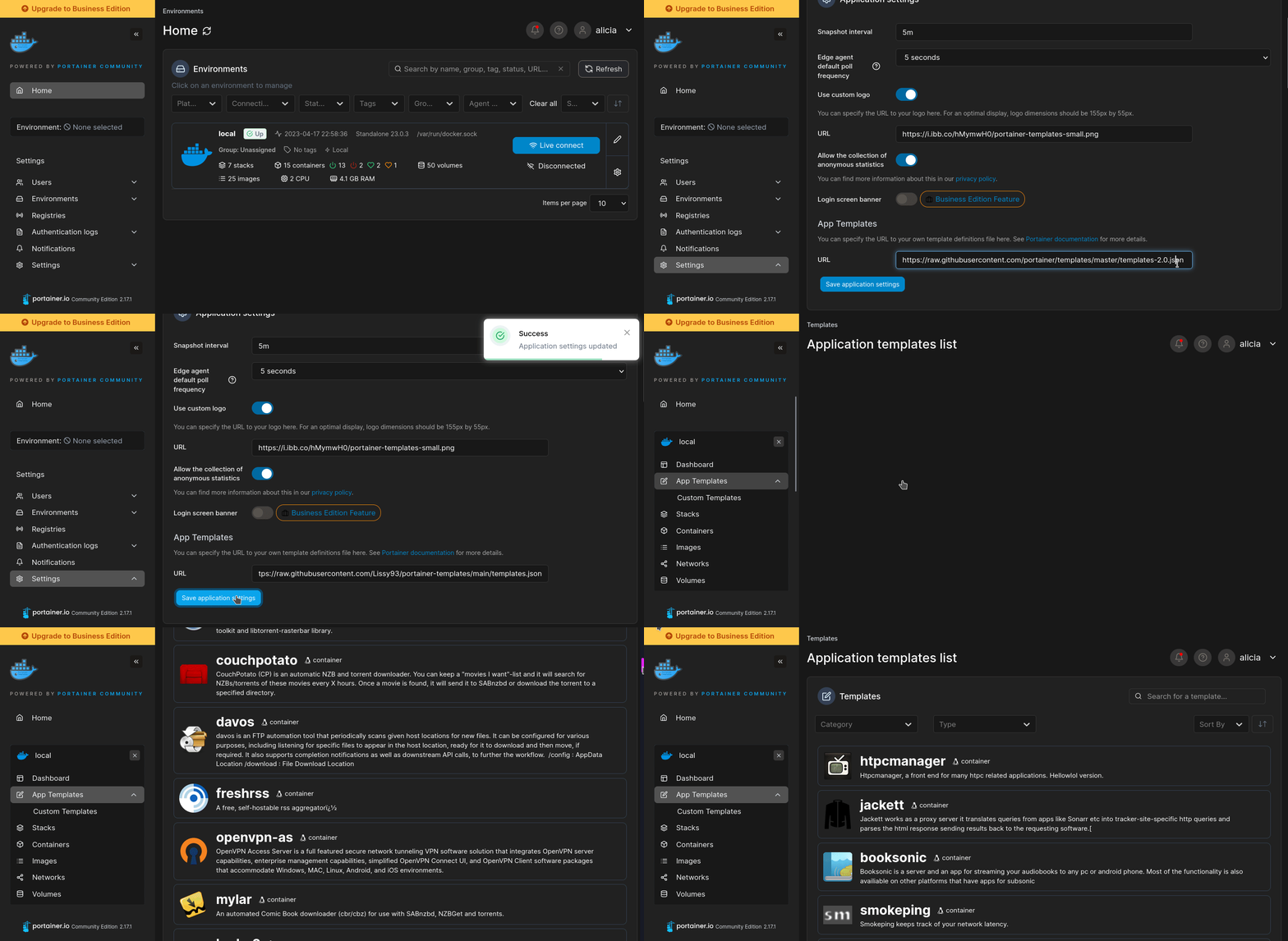
- Log into your Portainer web UI
- Under Settings → App Templates, paste the below URL
- Head to Home → App Templates, and the list of apps will show up
- Select PairDrop, fill in any config options, and hit Deploy
Template Import URL
https://raw.githubusercontent.com/Lissy93/portainer-templates/main/templates.json
Show Me
More install options in our documentation, or see schlagmichdoch/PairDrop for app-specific guidance.
<img src="https://raw.githubusercontent.com/schlagmichdoch/PairDrop/HEAD/public/images/android-chrome-512x512.png" alt="Logo" width="150" height="150">Local file sharing <a href="https://pairdrop.net"><strong>in your web browser</strong></a>.
<br>
Inspired by Apple's AirDrop.
<br>
Fork of Snapdrop.
<br>
<br>
<a href="https://github.com/schlagmichdoch/PairDrop/issues">Report a bug</a>
<br />
<a href="https://github.com/schlagmichdoch/PairDrop/issues">Request feature</a>Features
File sharing on your local network that works on all platforms.- A multi-platform AirDrop-like solution that works.
- Internet transfers
- Web-app
Share photos in original quality with friends using Android and iOS?
Share private files peer-to-peer between Linux systems?

Differences to the Snapdrop it is based on
View all differences
Paired Devices and Public Rooms — Internet Transfer
- Transfer files over the Internet between paired devices or by entering temporary public rooms.
- Connect to devices in complex network environments (public Wi-Fi, company network, iCloud Private Relay, VPN, etc.).
- Connect to devices on your mobile hotspot.
- Devices outside of your local network that are behind a NAT are auto-connected via the PairDrop TURN server.
- Devices from the local network, in the same public room, or previously paired are shown.
Persistent Device Pairing
Always connect to known devices- Pair devices via a 6-digit code or a QR-Code.
- Paired devices always find each other via shared secrets independently of their local network.
- Pairing is persistent. You find your devices even after reopening PairDrop.
- You can edit and unpair devices easily.
Temporary Public Rooms
Connect to others in complex network situations, or over the Internet.- Enter a public room via a 5-letter code or a QR-code.
- Enter a public room to temporarily connect to devices outside your local network.
- All devices in the same public room see each other.
- Public rooms are temporary. Closing PairDrop leaves all rooms.
Improved UI for Sending/Receiving Files
- Files are transferred after a request is accepted. Files are auto-downloaded upon completing a transfer, if possible.
- Multiple files are downloaded as a ZIP file
- Download, share or save to gallery via the "Share" menu on Android and iOS.
- Multiple files are transferred at once with an overall progress indicator.
Send Files or Text Directly From Share Menu, Context Menu or CLI
- Send files directly from context menu on Ubuntu (using Nautilus)
- Send files directly from the context menu on Windows
- Send directly from the "Share" menu on iOS
- Send directly from the "Share" menu on Android
- Send directly via the command-line interface
Other Changes
- Change your display name to easily differentiate your devices.
- Paste files/text and choose the recipient afterwards
- Prevent devices from sleeping on file transfer
- Warn user before PairDrop is closed on file transfer
- Open PairDrop on multiple tabs simultaneously (Thanks @willstott101)
- Video and audio preview (Thanks @victorwads)
- Switch theme back to auto/system after dark or light mode is on
- Node-only implementation (Thanks @Bellisario)
- Auto-restart on error (Thanks @KaKi87)
- Lots of stability fixes (Thanks @MWY001 @skiby7 and @willstott101)
- To host PairDrop on your local network (e.g. on Raspberry Pi): All peers connected with private IPs are discoverable by each other
- When hosting PairDrop yourself, you can set your own STUN/TURN servers
- Translations.
Translate PairDrop on Hosted Weblate

Built with the following awesome technologies:
- Vanilla HTML5 / JS ES6 / CSS 3 frontend
- WebRTC / WebSockets
- Node.js backend
- Progressive web app (PWA) unified functionality
- IndexedDB API storage handling
- zip.js library
- cyrb53 super-fast hash function
- NoSleep display sleep, add wake lock (MIT)
- heic2any HEIC/HEIF to PNG/GIF/JPEG (MIT)
- Weblate web-based localization tool
- BrowserStack This project is tested with BrowserStack
FAQ
Host your own instance with Docker or Node.js.
Support

PairDrop is libre, and always will be. \ If you find it useful and want to support free and open-source software, please consider donating using the button above. \ I footed the bill for the domain and the server, and you can help create and maintain great software by supporting me. \ Thank you very much for your contribution!
Contributing
Feel free to open an issue or a pull request, following the Contributing Guidelines.Serve PairDrop on your own domain behind Caddy, Nginx or Traefik. Fill in your domain and copy the result. It's a starting point, some apps need their own base URL or extra headers set too.
Proxying pairdrop.example.com to http://pairdrop:3000
Add this to your Caddyfile
pairdrop.example.com {
	reverse_proxy http://pairdrop:3000
}Check the logs first
Nine times out of ten the logs tell you exactly what went wrong.
- In Portainer, go to Containers, click the container, then Logs. Or run
docker logs pairdrop - Exit codes help too:
137means killed, usually out of memory.126or127means the command inside the image is broken.
Port already in use
If deployment fails with "Bind for 0.0.0.0:3000 failed: port is already allocated", something else on your server is using that port.
- Find what's using it:
sudo ss -tlnp | grep :3000 - Stop the other service, or pick a different host port. In
3000:3000only the left number is yours to change, the right one belongs to the app.
Running but the page won't load
The container is up but nothing appears in your browser.
- Use your server's real IP:
http://your-server-ip:3000. The 0.0.0.0 link Portainer shows isn't a real address. - Give it a minute after first deploy, pairdrop can take a while to initialise.
- Make sure your firewall allows the port, e.g.
sudo ufw allow 3000
Image won't pull
Test the pull directly on the host: docker pull lscr.io/linuxserver/pairdrop:latest
- "manifest unknown" means the tag no longer exists. This template uses
latest, so try pinning a specific version instead. - "toomanyrequests" is the Docker Hub rate limit. Log in with
docker loginto raise it. - "no space left on device" means a full disk. Reclaim space with
docker system prune
"exec format error"
This means the image was built for a different CPU architecture than your server.
- Check yours with
uname -m: x86_64 is amd64, aarch64 is arm64. Raspberry Pi and other ARM boards are the usual culprits.
Container keeps restarting
The unless-stopped restart policy relaunches the app after every crash, so the real error can scroll past.
- Check the logs right after a restart, the last few lines before it died are the useful ones.
- Get the exit code with
docker inspect pairdrop --format '{{.State.ExitCode}}' - Still stuck? Redeploy once with the restart policy set to
noso the failure stays visible.
Data disappears when the container is recreated
This template doesn't define any volumes, so everything pairdrop saves lives inside the container and is lost on update or recreate.
- Add a volume mapping for pairdrop's data folder before storing anything you care about.
Raise an issue
Found something which isn't working as it should? Here's how to report it.
- Bug within the app: Open an issue on schlagmichdoch/PairDrop
- Template not working: Open an issue within the template's repo
- This website not working: Open an issue on lissy93/portainer-templates
A single container
PairDrop runs as one container, the simplest kind of app here. Just the one image to pull and nothing else wired up alongside it.
The app image
An image is the app packed up ready to go, everything PairDrop needs bundled into one download. This template pulls lscr.io/linuxserver/pairdrop:latest, which Docker fetches once and then starts your own copy from.
Where the image comes from
Docker pulls its images from registries, public libraries of ready-built apps. PairDrop's comes from LinuxServer's registry, published by linuxserver.
Version tags
The bit after the colon in the image name is the version tag. Here it's latest, which always points at the newest build, so a redeploy can bump you to a newer release without you asking. Pin a specific tag if you would rather stay on one version.
Ports
A port is the door the app answers on. A mapping like 3000:3000 means it's reachable on port 3000 of your server, where the left number is yours to change and the right one belongs to the app. Once it's running, open http://your-server-ip:3000 in a browser. It opens:
3000:3000, likely the web interface
No stored data
This template doesn't mount any storage, so whatever PairDrop writes stays inside the container and is wiped if it's recreated or updated. That's fine for something stateless, but add a volume before trusting it with anything you want to keep.
Environment variables
Environment variables are the settings you hand over when you deploy, things like a password or a timezone. PairDrop takes 3 of them, all with defaults you can leave alone or tweak:
PUID, defaults to1000PGID, defaults to1000TZ, defaults toEtc/UTC
Restart policy
The restart policy here is unless-stopped, so Docker restarts PairDrop after a crash or reboot, but leaves it off when you stop it on purpose. You can change this on the deploy screen. The choices are no (never restart), on-failure (only after a crash), unless-stopped (restart unless you stop it), and always (bring it back no matter what).
Users and permissions
The PUID and PGID settings tell it which user and group to act as on your host. Point them at your own account (find yours with id $USER) so the files it writes into your mounted folders come out owned by you rather than root.
Networking
Nothing custom is set, so PairDrop sits on Docker's default bridge network: its own private space that reaches the outside world only through the ports it publishes.
Container name
Once it's deployed, Portainer names the container pairdrop. That's what you'll spot in the containers list and use in commands like docker logs pairdrop.
Platform
The platform is linux, the kind of system the container is built to run on. Docker and Portainer handle this on a normal Linux server.
Open source license
PairDrop is open source, released under the GPL-3.0 license. In plain terms the code is out in the open, so you're free to run it and change it to fit what you need.
Portainer app templates
Zooming out, this whole page comes from a Portainer app template: a short recipe telling Portainer how to set PairDrop up. Add the template list to Portainer once, then deploying PairDrop is a click rather than a wall of config.