
![Cloudflared-web]() Cloudflared-web
Cloudflared-web
Container
A docker image that packages both cloudflared cli and a simple Web UI to easily start or stop remotely-managed Cloudflare tunnel. Source: https://github.com/WisdomSky/Cloudflared-web
Image details
Source details
Configuration
TypeContainerlinuxwisdomsky/cloudflared-web:latest/configWEBUI_PORT=14333BASIC_AUTH_USER=adminBASIC_AUTH_PASS=unless-stoppedStandalone Install
Select an install method, to see config/commands for deploying Cloudflared-web
Install on Portainer
Import all app templates into your Portainer instance, for easy 1-click deploys
- Ensure both Docker and Portainer are installed, and up-to-date
- Log into your Portainer web UI
- Under Settings → App Templates, paste the below URL
- Head to Home → App Templates, and the list of apps will show up
- Select Cloudflared-web, fill in any config options, and hit Deploy
Template Import URL
https://raw.githubusercontent.com/Lissy93/portainer-templates/main/templates.json
Show Me
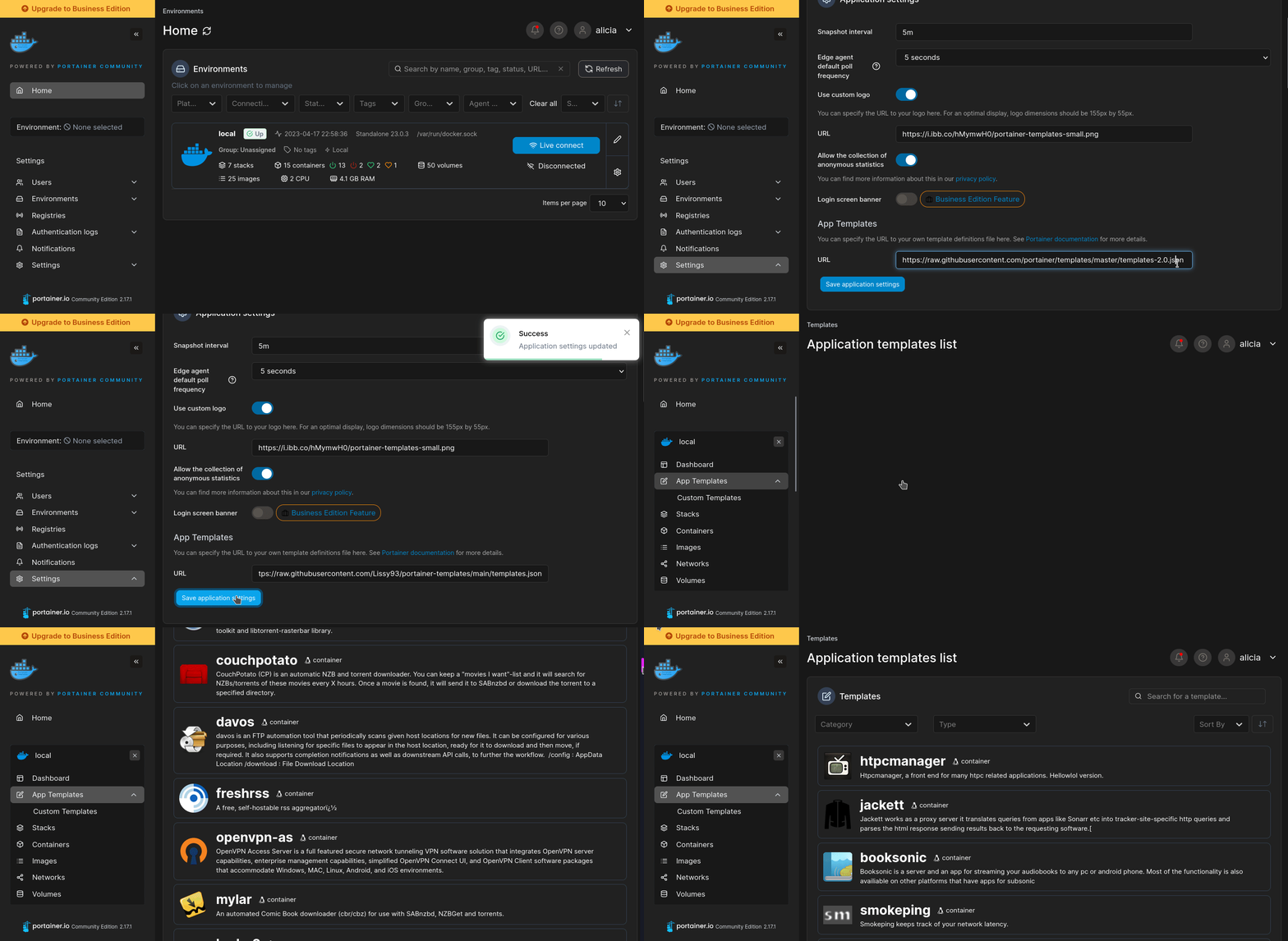
More install options in our documentation, or see WisdomSky/Cloudflared-web for app-specific guidance.
Cloudflared-web
Cloudflared-web is a docker image that packages both cloudflared cli and a simple Web UI to easily start or stop remotely-managed Cloudflare tunnel.Repository: https://github.com/WisdomSky/Cloudflared-web




✅ Easy run-and-forget setup.
✅ Manage cloudflared token from a simple and user-friendly Web UI.
✅ Start and stop cloudflare tunnel anytime with a single click.
---
Application Setup
When manually setting up this image, it is crucial to always set thenetworking mode into host as without it, the cloudflared service won't be able to access the services running on the host:docker run --network host wisdomsky/cloudflared-web:latestdocker-compose.yml:services:
cloudflared:
image: wisdomsky/cloudflared-web:latest
restart: unless-stopped
network_mode: hostThe Web UI where you can setup the Cloudflared token can be accessed from port
14333:http://localhost:14333Github Containers
If for some reason you are unable to pull images from Docker's Official Image Registry (docker.io),Cloudflared-web is also synced to Github Container Registry (ghcr.io).Just prefix the image with
ghcr.io/ in order to use the mirrored image in Github.
services:
cloudflared:
image: ghcr.io/wisdomsky/cloudflared-web:latest
restart: unless-stopped
network_mode: hostAdditional Parameters
Environment
| Variable Name | Default value | Required or Optional | Description |
|---|---|---|---|
| WEBUIHOST | 0.0.0.0 | Optional | This will work if you want the WebUI to listen on a different host address |
| WEBUIPORT | 14333 | Optional | The port on the host where the WebUI will be running. Useful when an existing process is running on port 14333 and want to assign cloudflared-web into a different available port. |
| BASICAUTHPASS | Optional | Enable Basic Auth by specifying a password. If BASICAUTHUSER is not specified, the default value for username admin will be used. | |
| BASICAUTHUSER | admin | Optional | Specify the username for the Basic Auth. |
| EDGEBINDADDRESS | Optional | Specifies the outgoing IP address used to establish a connection between cloudflared and the Cloudflare global network.The IP version of EDGEBINDADDRESS will override EDGEIPVERSION (if provided). For example, if you enter an IPv6 source address, cloudflared will always connect to an IPv6 destination. | |
| EDGEIPVERSION | auto | Optional | Specifies the IP address version (IPv4 or IPv6) used to establish a connection between cloudflared and the Cloudflare global network. Available values are auto, 4, and 6. |
| PROTOCOL | auto | Optional | Specifies the protocol used to establish a connection between cloudflared and the Cloudflare global network. Available values are auto, http2, and quic. |
| GRACEPERIOD | 30s | Optional | When cloudflared receives SIGINT/SIGTERM it will stop accepting new requests, wait for in-progress requests to terminate, then shut down. Waiting for in-progress requests will timeout after this grace period, or when a second SIGTERM/SIGINT is received. |
| REGION | Optional | Allows you to choose the regions to which connections are established. Currently the only available value is us, which routes all connections through data centers in the United States. Omit or leave empty to connect to the global region. | |
| RETRIES | 5 | Optional | Specifies the maximum number of retries for connection/protocol errors. Retries use exponential backoff (retrying at 1, 2, 4, 8, 16 seconds by default), so it is NOT RECOMMENDED that you increase this value significantly. |
| METRICSENABLE | false | Optional | Enable tunnel metrics server. |
| METRICSPORT | 60123 | Optional | Specify port to run tunnel metrics on. METRICSENABLE must be set to true. |
Based on Cloudflare tunel run parameters documentation.
example
docker-compose.yaml:
services:
  cloudflared:
    image: wisdomsky/cloudflared-web:latest
    restart: unless-stopped
    network_mode: host
environment:
WEBUI_PORT: 1111
PROTOCOL: http2Volume
| Container Path | Required or Optional | Description |
|---|---|---|
| /config | Optional | The path to the directory where the config.json file containing the Cloudflare token and start status will be saved. |
example
docker-compose.yaml:
services:
  cloudflared:
    image: wisdomsky/cloudflared-web:latest
    restart: unless-stopped
    network_mode: host
    volumes:
      - /mnt/storage/cloudflared/config:/config
Using Networks
You can use dockernetworks for a more fine-grained control of which containers/services your cloudflared-web container has access to.services:
cloudflared:
image: wisdomsky/cloudflared-web:latest
restart: unless-stopped
networks:
- mynetwork
environment:
WEBUI_PORT: 1111Screenshots
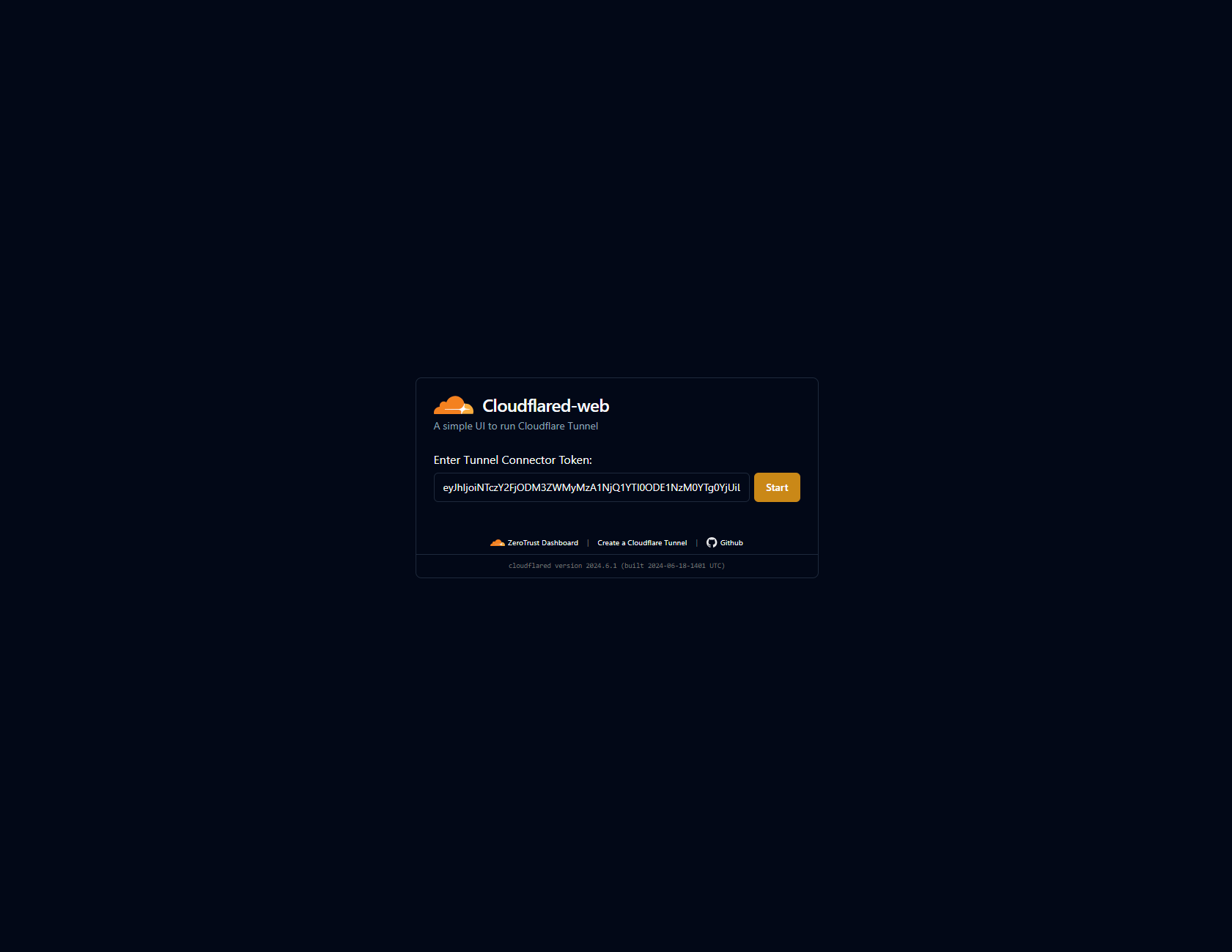
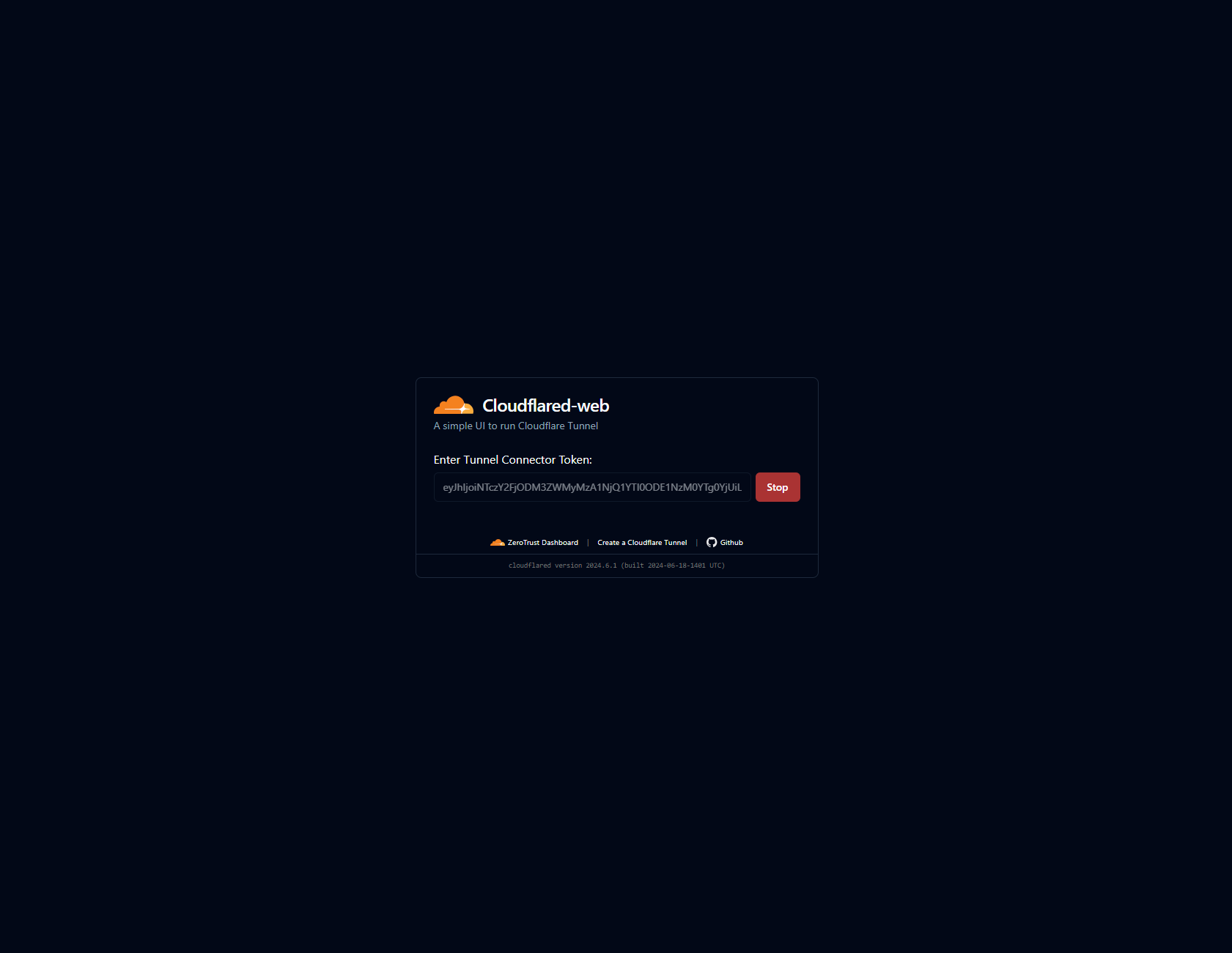
Issues
For any problems experienced while using the docker image, please create a new issue.---
Contribute
Adding A Language Translation
See Localization.Check the logs first
Nine times out of ten the logs tell you exactly what went wrong.
- In Portainer, go to Containers, click the container, then Logs. Or run
docker logs cloudflared-web - Exit codes help too:
137means killed, usually out of memory.126or127means the command inside the image is broken.
Runs on the host network
This container shares your server's network directly, so port mappings are ignored and every port the app opens binds straight to the host.
- If a port won't bind, find the clash with
sudo ss -tlnpand stop the other service, or change the port in cloudflared-web's own settings.
Image won't pull
Test the pull directly on the host: docker pull wisdomsky/cloudflared-web:latest
- "manifest unknown" means the tag no longer exists. This template uses
latest, so try pinning a specific version instead. - "toomanyrequests" is the Docker Hub rate limit. Log in with
docker loginto raise it. - "no space left on device" means a full disk. Reclaim space with
docker system prune
"exec format error"
This means the image was built for a different CPU architecture than your server.
- This image supports:
amd64, arm64, arm/v7, arm64/v8 - Check yours with
uname -m: x86_64 is amd64, aarch64 is arm64. Raspberry Pi and other ARM boards are the usual culprits.
Container keeps restarting
The unless-stopped restart policy relaunches the app after every crash, so the real error can scroll past.
- Check the logs right after a restart, the last few lines before it died are the useful ones.
- Get the exit code with
docker inspect cloudflared-web --format '{{.State.ExitCode}}' - Still stuck? Redeploy once with the restart policy set to
noso the failure stays visible.
Required settings are blank
BASIC_AUTH_PASS has no default value, and cloudflared-web may crash or misbehave if left empty.
- Fill it in on the deploy screen before hitting deploy.
Raise an issue
Found something which isn't working as it should? Here's how to report it.
- Bug within the app: Open an issue on WisdomSky/Cloudflared-web
- Template not working: Open an issue within the template's repo
- This website not working: Open an issue on lissy93/portainer-templates
A single container
Cloudflared-web runs as one container, the simplest kind of app here. Just the one image to pull and nothing else wired up alongside it.
The app image
An image is the app packed up ready to go, everything Cloudflared-web needs bundled into one download. This template pulls wisdomsky/cloudflared-web:latest, which Docker fetches once (about 226 MB) and then starts your own copy from.
Where the image comes from
Docker pulls its images from registries, public libraries of ready-built apps. Cloudflared-web's comes from Docker Hub, published by wisdomsky.
Version tags
The bit after the colon in the image name is the version tag. Here it's latest, which always points at the newest build, so a redeploy can bump you to a newer release without you asking. Newest right now is 2026.9.3. Pin a specific tag if you would rather stay on one version.
Which machines it runs on
Every image is built for particular CPU types. This one ships for amd64, arm64, arm/v7, arm64/v8, so it runs on both regular x86 servers and ARM boards like a Raspberry Pi.
Volumes
A volume is where Cloudflared-web keeps its files so they survive an update or a restart. Without one, anything it saves would sit inside the container and vanish the moment it's recreated. This template mounts:
/configas a volume Docker manages for you
Environment variables
Environment variables are the settings you hand over when you deploy, things like a password or a timezone. Cloudflared-web takes 3 of them, and one needs a value before it'll start properly:
WEBUI_PORT, defaults to14333. Web UI portBASIC_AUTH_USER, defaults toadmin. Web UI usernameBASIC_AUTH_PASS, needs a value. Web UI password (set to protect the tunnel controls)
Restart policy
The restart policy here is unless-stopped, so Docker restarts Cloudflared-web after a crash or reboot, but leaves it off when you stop it on purpose. You can change this on the deploy screen. The choices are no (never restart), on-failure (only after a crash), unless-stopped (restart unless you stop it), and always (bring it back no matter what).
Networking
Cloudflared-web runs on the host network, so it shares your server's networking directly instead of getting a private one of its own. Its ports open straight on the server with no mapping in between.
Container name
Once it's deployed, Portainer names the container cloudflared-web. That's what you'll spot in the containers list and use in commands like docker logs cloudflared-web.
Platform
The platform is linux, the kind of system the container is built to run on. Docker and Portainer handle this on a normal Linux server.
Open source license
Cloudflared-web is open source, released under the GPL-2.0 license. In plain terms the code is out in the open, so you're free to run it and change it to fit what you need.
Portainer app templates
Zooming out, this whole page comes from a Portainer app template: a short recipe telling Portainer how to set Cloudflared-web up. Add the template list to Portainer once, then deploying Cloudflared-web is a click rather than a wall of config.