
![Grocy (stack)]() Grocy (stack)
Grocy (stack)
Grocy is an ERP system for your kitchen! Cut down on food waste, and manage your chores with this brilliant utility.
Source: https://github.com/grocy/grocy
Source details
Configuration
TypeComposelinuxlscr.io/linuxserver/grocy:latest9283:80/config : /portainer/Files/AppData/Config/GrocyPUID=1000PGID=1000TZ=Europe/Athensunless-stoppedStandalone Install
Select an install method, to see config/commands for deploying Grocy (stack)
Install on Portainer
Import all app templates into your Portainer instance, for easy 1-click deploys
- Ensure both Docker and Portainer are installed, and up-to-date
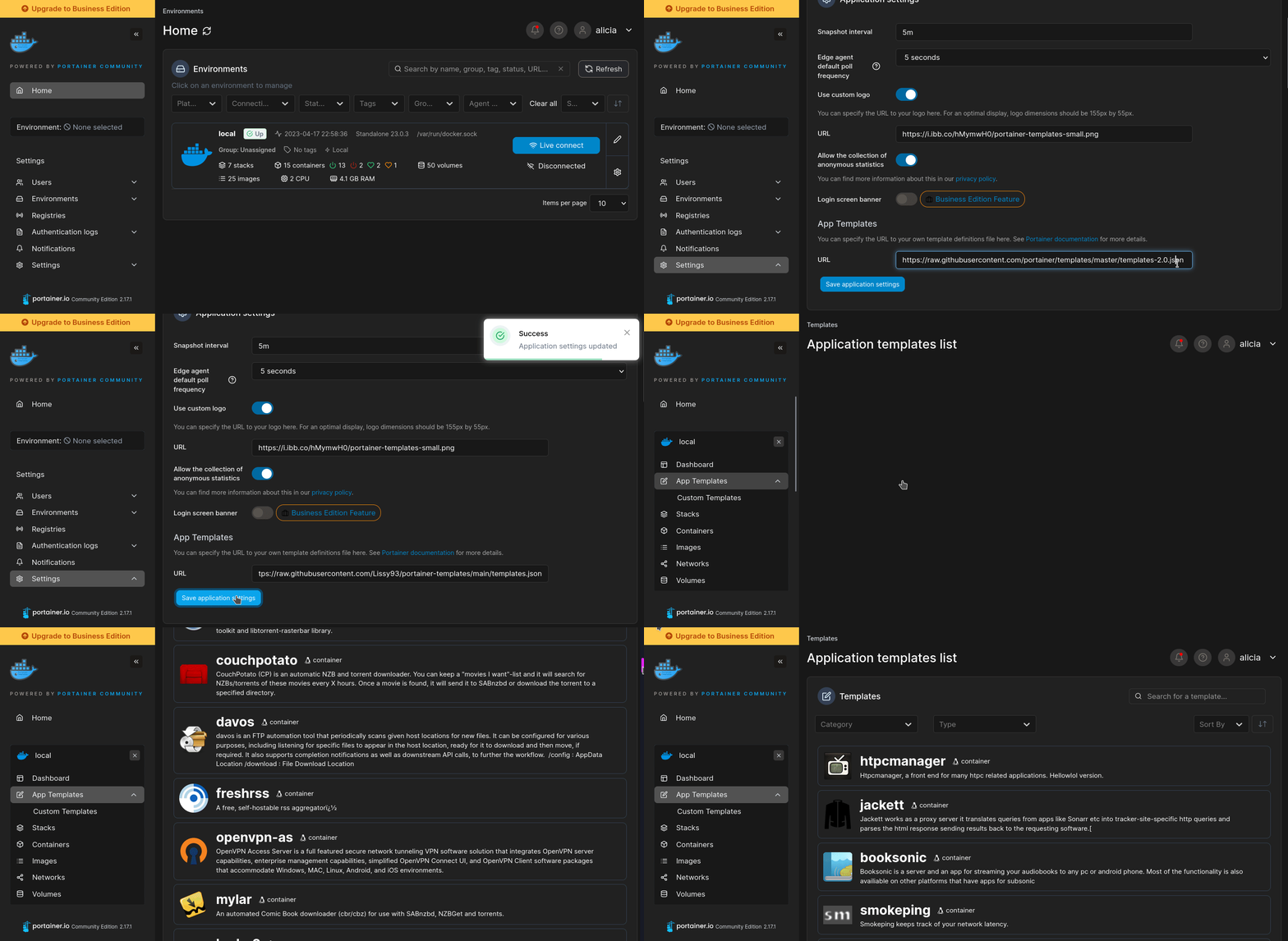
- Log into your Portainer web UI
- Under Settings → App Templates, paste the below URL
- Head to Home → App Templates, and the list of apps will show up
- Select Grocy (stack), fill in any config options, and hit Deploy
Template Import URL
https://raw.githubusercontent.com/Lissy93/portainer-templates/main/templates.json
Show Me
Original stackfile
The compose file this template deploys, straight from its repo:
services:
  grocy:
    image: lscr.io/linuxserver/grocy:latest
    container_name: grocy
    environment:
      PUID: 1000
      PGID: 1000
      TZ: 'Europe/Athens'
    volumes:
      - /portainer/Files/AppData/Config/Grocy:/config
    ports:
      - 9283:80
    restart: unless-stopped
Or deploy it directly from the source:
git clone https://github.com/xneo1/portainer_templates
cd portainer_templates
docker compose -f Template/Stack/grocy.yml up -d
More install options in our documentation, or see grocy/grocy for app-specific guidance.

ERP beyond your fridge
Grocy is a web-based self-hosted groceries & household management solution for your home
This is a hobby project by Bernd Bestel
Give it a try
- Public demo of the latest stable version (
releasebranch) → https://demo.grocy.info - Public demo of the current development version (
masterbranch) → https://demo-prerelease.grocy.info
Features
See the website. →Questions / Help / Bug Reports / Feature Requests
- General help and usage questions → r/grocy on Reddit
- Bug Reports and Feature Requests → Issue Tracker
Please don't send me private messages or call me regarding anything Grocy. I check the issue tracker and the subreddit pretty much daily, but don't provide any support beyond that.
Community contributions
See the website for a list of community contributed Add-ons / Tools. → https://grocy.info/addonsHow to install
Checkout Grocy Desktop, if you want to run Grocy without having to manage a webserver just like a normal (Windows) desktop application.
Directly download the latest release (also available via the Microsoft Store) - the installation is nothing more than just clicking 2 times "next".
Grocy is technically a pretty simple PHP application, so the basic notes to get it running are:
- Unpack the latest release
- Copy
config-dist.phptodata/config.php+ edit to your needs - Ensure that the
datadirectory is writable - The webserver root should point to the
publicdirectory - Include
try_files $uri /index.php$is_args$query_string;in your location block if you use nginx
DISABLE_URL_REWRITING in data/config.php)- → Default login is user
adminwith passwordadmin, please change the password immediately (user menu at the top right corner)
Alternatively clone this repository (the
release branch always references the latest released version) and install Composer and Yarn dependencies manually.See the website for more installation guides and troubleshooting help. → https://grocy.info/links
Platform support
- PHP 8.5 (with SQLite 3.40+)
fileinfo, pdo_sqlite, gd, ctype, intl, zlib, mbstring- Recent Firefox, Chrome or Edge
How to run using Docker
→ https://hub.docker.com/r/linuxserver/grocyHow to update
- Overwrite everything with the latest release while keeping the
datadirectory - Check
config-dist.phpfor new configuration options and add them to yourdata/config.phpwhere appropriate (the default values fromconfig-dist.phpwill be used for not indata/config.phpdefined settings)
If you run Grocy on Linux, there is also
update.sh (remember to make the script executable via chmod +x update.sh and ensure that you have unzip installed) which does exactly this and additionally creates a backup (.tgz archive) of the current installation in data/backups (backups older than 60 days will be deleted during the update).Localization
Grocy is fully localizable - the default language is English (integrated into code), a German localization is always maintained by me.You can easily help translating Grocy on Transifex if your language is incomplete or not available yet.
The default language can be set in
data/config.php, e. g. Setting('DEFAULT_LOCALE', 'de'); and there is also a user setting (see the user settings page) to set a different language per user.The pre-release demo is available for any translation which is at least 70 % complete and will pull the translations from Transifex 10 minutes past every hour, so you can have a kind of instant preview of your contributed translations. Thank you!
Also any translation which once reached a completion level of 70 % (
strings resource) will be included in releases.RTL languages are not yet supported.
Motivation
A household needs to be managed. Before Grocy I did this (for almost 10 years) using my first self written software (a C# Windows forms application) and with a bunch of Excel sheets. The software was a pain to use at the end and Excel is Excel. So I searched for and tried different things for a (very) long time, nothing 100 % fitted, so this is my aim for a "complete household management"-thing. ERP your fridge!Things worth to know
REST API
See the integrated Swagger UI instance on /api.The web frontend uses exactly this API for pretty much everything. So everything you can do there is also possible via the API.
Barcode readers & camera scanning
Some fields (with a barcode icon) also allow to select a value by scanning a barcode. It works best when your barcode reader prefixes every barcode with a letter which is normally not part of a item name (I use a$) and sends a TAB after a scan.Additionally it's also possible to use your device camera to scan a barcode by using the camera button on the right side of the corresponding input field (powered by ZXing, totally offline / client-side camera stream processing. Please note due to browser security restrictions, this only works when serving Grocy via a secure connection (
https://)). Here and there are quick video demos of that.My personal recommendation: Use a USB barcode laser scanner. They are cheap and work 1000% better, faster, under any lighting condition and from any angle.
Barcode lookup via external services
Products can be directly added to the database via looking them up against external services by a barcode.This can be done in-place using the product picker workflow "External barcode lookup" (the workflow dialog is displayed when entering something unknown in any product input field) Quick video demo:
A plugin for Open Food Facts is included and used by default (see the
data/config.php option STOCK_BARCODE_LOOKUP_PLUGIN).See that plugin or
plugins/DemoBarcodeLookupPlugin.php for a commented example implementation if you want to build a plugin.Input shorthands for date fields
For (productivity) reasons all date (and time) input (and display) fields use the ISO-8601 format regardless of localization. The following shorthands are available:MMDDgets expanded to the given day on the current year, if > today, or to the given day next year, if < today, in proper notation
0517 will be converted to 2026-05-17YYYYMMDDgets expanded to the proper ISO-8601 notation
20260417 will be converted to 2026-04-17YYYYMMeorYYYYMM+gets expanded to the end of the given month in the given year in proper notation
202607e will be converted to 2026-07-31[+/-]n[d/m/y]gets expanded to a date relative to today, while adding (+) or subtracting (-) the number of days/months/years, in proper notation
+1m will be converted to the same day next monthxgets expanded to2999-12-31(which is an alias for "never overdue")- Down/up arrow keys will increase/decrease the date by 1 day
- Right/left arrow keys will increase/decrease the date by 1 week
- Shift + down/up arrow keys will increase/decrease the date by 1 month
- Shift + right/left arrow keys will increase/decrease the date by 1 year
Keyboard shorthands for buttons
Wherever a button contains a bold highlighted letter, this is a shortcut key. Example: Button "P Add as new product" can be "pressed" by using theP key on your keyboard.Installable web app (PWA)
Grocy's web frontend is responsive and an "installable web app" (PWA, without providing any offline usage capabilities), that provides a pretty native mobile app-like experience without the need for additional tools.- Quick video demo on Android/Firefox:
- Quick video demo on Android/Chrome:
Database migrations
Database schema migration is done when visiting the root (/) route (click on the logo in the left upper edge) as needed and is also triggered automatically if the version has changed (so when an update has been made).Please note: Database migrations are supposed to work between releases, not between every commit. If you want to run the current
master branch (which is the development version), you need to handle that (and more) yourself.Disable certain features
If you don't use certain feature sets of Grocy (for example if you don't need "Chores"), there are feature flags per major feature set to hide/disable the related UI elements (seeconfig-dist.php).Adding your own CSS or JS without to have to modify the application itself
- When the file
data/custom_js.htmlexists, the contents of the file will be added just before</body>(end of body) on every page - When the file
data/custom_css.htmlexists, the contents of the file will be added just before</head>(end of head) on every page
Demo mode
When theMODE setting is set to dev, demo or prerelease, the application will work in a demo mode which means authentication is disabled and some demo data will be generated during the database schema migration (pass the query parameter nodemodata, e.g. https://grocy.example.com/?nodemodata to skip that).Embedded mode
When the fileembedded.txt exists, it must contain a valid and writable path which will be used as the data directory instead of data and authentication will be disabled (used in Grocy Desktop).In embedded mode, settings can be overridden by text files in
data/settingoverrides, the file name must be <SettingName>.txt (e. g. BASE_URL.txt) and the content must be the setting value (normally one single line).Contributing / Say Thanks
SeeRoadmap
There is none. The progress of a specific bug/enhancement is always tracked in the corresponding request, at least by commit comment references.Milestones are used to indicate in which version the corresponding request was done (
vNEXT means it's currently planned to do that for the next release).Screenshots
Stock overview

Shopping List

Meal Plan

Chores overview

License
The MIT License (MIT)Serve Grocy (stack) on your own domain behind Caddy, Nginx or Traefik. Fill in your domain and copy the result. It's a starting point, some apps need their own base URL or extra headers set too.
Proxying grocy-stack.example.com to http://grocy:80
Add this to your Caddyfile
grocy-stack.example.com {
	reverse_proxy http://grocy:80
}Check the logs first
Nine times out of ten the logs tell you exactly what went wrong.
- In Portainer, go to Containers, click the container, then Logs. Or run
docker logs <container> - Exit codes help too:
137means killed, usually out of memory.126or127means the command inside the image is broken.
Port already in use
If deployment fails with "Bind for 0.0.0.0:9283 failed: port is already allocated", something else on your server is using that port.
- Find what's using it:
sudo ss -tlnp | grep :9283 - Stop the other service, or pick a different host port. In
9283:80only the left number is yours to change, the right one belongs to the app.
Running but the page won't load
The container is up but nothing appears in your browser.
- Use your server's real IP:
http://your-server-ip:9283. The 0.0.0.0 link Portainer shows isn't a real address. - Give it a minute after first deploy, grocy can take a while to initialise.
- Make sure your firewall allows the port, e.g.
sudo ufw allow 9283
Permission denied on volumes
If the logs show "permission denied", the app can't write to its data folder on the host.
- Fix the ownership:
sudo chown -R 1000:1000 /portainer/Files/AppData/Config/Grocy - Or set the
PUIDandPGIDvariables (defaults 1000:1000) to match your own user, found withid $USER
Image won't pull
Test the pull directly on the host: docker pull lscr.io/linuxserver/grocy:latest
- "manifest unknown" means the tag no longer exists. This template uses
latest, so try pinning a specific version instead. - "toomanyrequests" is the Docker Hub rate limit. Log in with
docker loginto raise it. - "no space left on device" means a full disk. Reclaim space with
docker system prune
"exec format error"
This means the image was built for a different CPU architecture than your server.
- Check yours with
uname -m: x86_64 is amd64, aarch64 is arm64. Raspberry Pi and other ARM boards are the usual culprits.
Container keeps restarting
The unless-stopped restart policy relaunches the app after every crash, so the real error can scroll past.
- Check the logs right after a restart, the last few lines before it died are the useful ones.
- Get the exit code with
docker inspect <container> --format '{{.State.ExitCode}}' - Still stuck? Redeploy once with the restart policy set to
noso the failure stays visible.
Stack won't deploy
Compose stacks fail fast on small mistakes, and Portainer shows the reason just above the editor.
- YAML only accepts spaces for indentation, a single tab breaks the whole file.
Raise an issue
Found something which isn't working as it should? Here's how to report it.
- Bug within the app: Open an issue on grocy/grocy
- Template not working: Open an issue on xneo1/portainer_templates
- This website not working: Open an issue on lissy93/portainer-templates
A Compose stack
Grocy (stack) is a Compose stack, a set of containers defined in one file and brought up together by Portainer, then started and stopped as a single app.
The app image
An image is the app packed up ready to go, everything Grocy (stack) needs bundled into one download. This template pulls lscr.io/linuxserver/grocy:latest, which Docker fetches once and then starts your own copy from.
Where the image comes from
Docker pulls its images from registries, public libraries of ready-built apps. Grocy (stack)'s comes from LinuxServer's registry, published by linuxserver.
Version tags
The bit after the colon in the image name is the version tag. Here it's latest, which always points at the newest build, so a redeploy can bump you to a newer release without you asking. Pin a specific tag if you would rather stay on one version.
Ports
A port is the door the app answers on. A mapping like 9283:80 means it's reachable on port 9283 of your server, where the left number is yours to change and the right one belongs to the app. Once it's running, open http://your-server-ip:9283 in a browser. It opens:
9283:80, likely the web interface
Volumes
A volume is where Grocy (stack) keeps its files so they survive an update or a restart. Without one, anything it saves would sit inside the container and vanish the moment it's recreated. This template mounts:
/configfrom/portainer/Files/AppData/Config/Grocyon the host
Environment variables
Environment variables are the settings you hand over when you deploy, things like a password or a timezone. Grocy (stack) takes 3 of them, all with defaults you can leave alone or tweak:
PUID, defaults to1000PGID, defaults to1000TZ, defaults toEurope/Athens
Restart policy
The restart policy here is unless-stopped, so Docker restarts Grocy (stack) after a crash or reboot, but leaves it off when you stop it on purpose. You can change this on the deploy screen. The choices are no (never restart), on-failure (only after a crash), unless-stopped (restart unless you stop it), and always (bring it back no matter what).
Users and permissions
The PUID and PGID settings tell it which user and group to act as on your host. Point them at your own account (find yours with id $USER) so the files it writes into your mounted folders come out owned by you rather than root.
Networking
Nothing custom is set, so Grocy (stack) sits on Docker's default bridge network: its own private space that reaches the outside world only through the ports it publishes.
Container name
Once it's deployed, Portainer names the container grocy. That's what you'll spot in the containers list and use in commands like docker logs grocy.
Platform
The platform is linux, the kind of system the container is built to run on. Docker and Portainer handle this on a normal Linux server.
Open source license
Grocy (stack) is open source, released under the MIT license. In plain terms the code is out in the open, so you're free to run it and change it to fit what you need.
Portainer app templates
Zooming out, this whole page comes from a Portainer app template: a short recipe telling Portainer how to set Grocy (stack) up. Add the template list to Portainer once, then deploying Grocy (stack) is a click rather than a wall of config.