
![Reactive-Resume]() Reactive-Resume
Reactive-Resume
Container
A one-of-a-kind resume builder that's not out to get your data. Completely secure, customizable, portable, open-source and free forever.
Image details
Source details
Configuration
TypeContainerlinuxamruthpillai/reactive-resume:latest80/tcp/usr/src/app : /portainer/Files/AppData/Config/ReactiveResumeunless-stoppedTemplate by xneo1
Standalone Install
Select an install method, to see config/commands for deploying Reactive-Resume
Install on Portainer
Import all app templates into your Portainer instance, for easy 1-click deploys
- Ensure both Docker and Portainer are installed, and up-to-date
- Log into your Portainer web UI
- Under Settings → App Templates, paste the below URL
- Head to Home → App Templates, and the list of apps will show up
- Select Reactive-Resume, fill in any config options, and hit Deploy
Template Import URL
https://raw.githubusercontent.com/Lissy93/portainer-templates/main/templates.json
Show Me
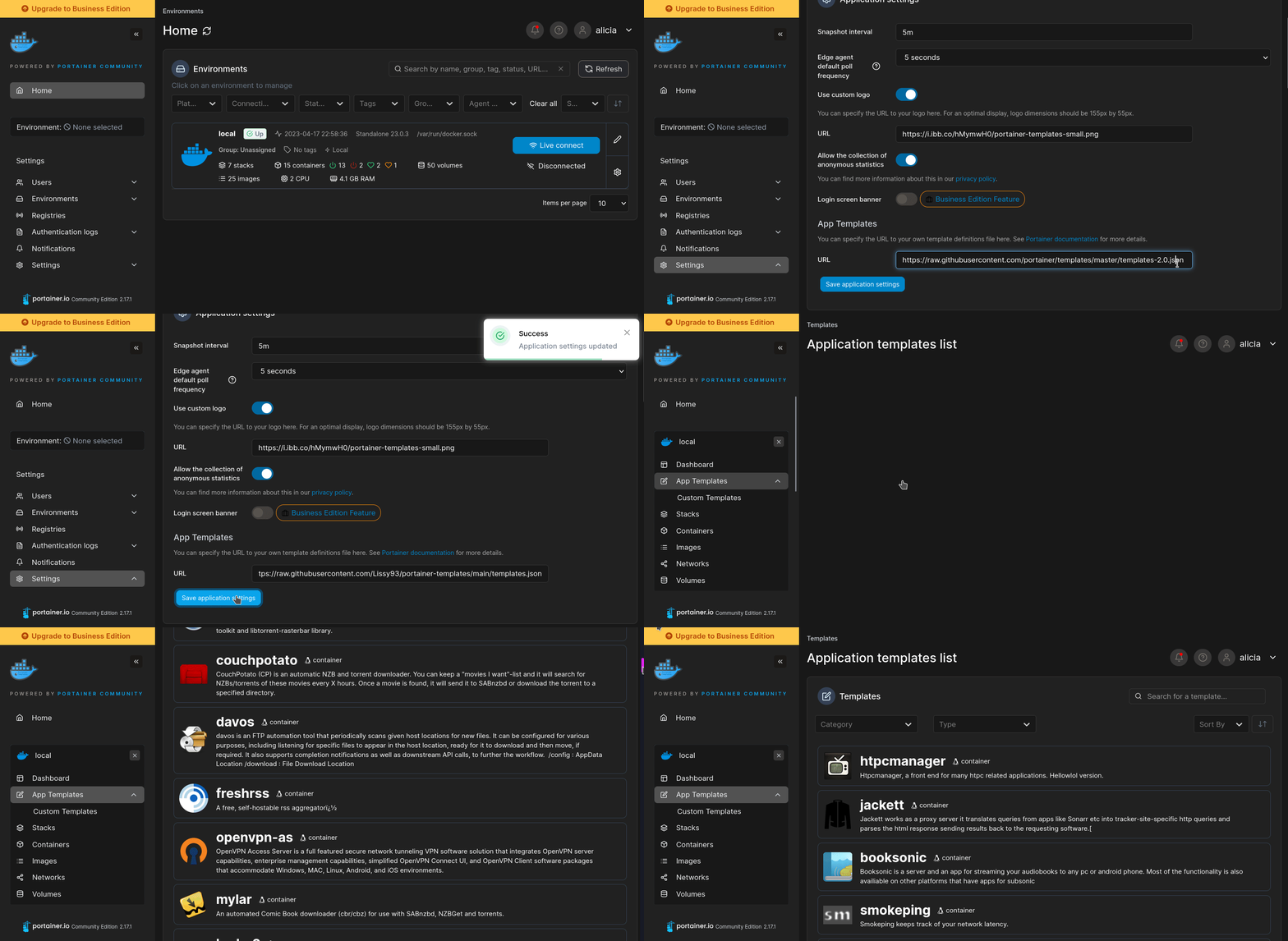
More install options in our documentation, or see amruthpillai/reactive-resume for app-specific guidance.
<img src="public/opengraph/banner.jpg" alt="Reactive Resume" />Reactive Resume
Reactive Resume is a free and open-source resume builder that simplifies the process of creating, updating, and sharing your resume.
<a href="https://rxresu.me"><strong>Get Started</strong></a>
·
<a href="https://docs.rxresu.me"><strong>Learn More</strong></a>
<img src="https://img.shields.io/github/stars/AmruthPillai/Reactive-Resume?style=flat-square" alt="Stars" />
<img src="https://img.shields.io/github/license/AmruthPillai/Reactive-Resume?style=flat-square" alt="License" />
<img src="https://img.shields.io/docker/pulls/amruthpillai/reactive-resume?style=flat-square" alt="Docker Pulls" />
<a href="https://discord.gg/hzwkZbyvUW"><img src="https://img.shields.io/discord/1173518977851473940?label=Discord&style=flat-square&logo=discord" alt="Discord" /></a>
<a href="https://crowdin.com/project/reactive-resume"><img src="https://badges.crowdin.net/reactive-resume/localized.svg?style=flat-square" alt="Crowdin" /></a>
<a href="https://opencollective.com/reactive-resume"><img src="https://img.shields.io/opencollective/all/reactive-resume?style=flat-square" alt="Open Collective" /></a>
Reactive Resume makes building resumes straightforward. Pick a template, fill in your details, and export to PDF—no account required for basic use. For those who want more control, the entire application can be self-hosted on your own infrastructure.
Built with privacy as a core principle, Reactive Resume gives you complete ownership of your data. The codebase is fully open-source under the MIT license, with no tracking, no ads, and no hidden costs.
Features
Resume Building- Real-time preview as you type
- Multiple export formats (PDF, JSON)
- Drag-and-drop section ordering
- Custom sections for any content type
- Rich text editor with formatting support
Templates
- Professionally designed templates
- A4 and Letter size support
- Customizable colors, fonts, and spacing
- Custom CSS for advanced styling
Privacy & Control
- Self-host on your own infrastructure
- No tracking or analytics by default
- Full data export at any time
- Delete your data permanently with one click
Extras
- AI integration (OpenAI, Google Gemini, Anthropic Claude)
- Multi-language support
- Share resumes via unique links
- Import from JSON Resume format
- Dark mode support
- Passkey and two-factor authentication
Templates
Quick Start
The quickest way to run Reactive Resume locally:# Clone the repository
git clone https://github.com/AmruthPillai/Reactive-Resume.git
cd Reactive-Resume
# Start all services
docker compose up -d
# Access the app
open http://localhost:3000For detailed setup instructions, environment configuration, and self-hosting guides, see the documentation.
Tech Stack
| Category | Technology |
|---|---|
| Framework | TanStack Start (React 19, Vite) |
| Runtime | Node.js |
| Language | TypeScript |
| Database | PostgreSQL with Drizzle ORM |
| API | ORPC (Type-safe RPC) |
| Auth | Better Auth |
| Styling | Tailwind CSS |
| UI Components | Radix UI |
| State Management | Zustand + TanStack Query |
Documentation
Comprehensive guides are available at docs.rxresu.me:| Guide | Description |
|---|---|
| Getting Started | First-time setup and basic usage |
| Self-Hosting | Deploy on your own server |
| Development Setup | Local development environment |
| Project Architecture | Codebase structure and patterns |
| Exporting Your Resume | PDF and JSON export options |
Self-Hosting
Reactive Resume can be self-hosted using Docker. The stack includes:- PostgreSQL — Database for storing user data and resumes
- Gotenberg — Headless Chrome service for PDF generation
- SeaweedFS (optional) — S3-compatible storage for file uploads
Pull the latest image from Docker Hub or GitHub Container Registry:
# Docker Hub
docker pull amruthpillai/reactive-resume:latest

# GitHub Container Registry
docker pull ghcr.io/amruthpillai/reactive-resume:latest
See the self-hosting guide for complete instructions.
Support
Reactive Resume is and always will be free and open-source. If it has helped you land a job or saved you time, please consider supporting continued development:
<img src="https://img.shields.io/badge/GitHub%20Sponsors-Support-ea4aaa?style=flat-square&logo=github-sponsors" alt="GitHub Sponsors" /><img src="https://img.shields.io/badge/Open%20Collective-Contribute-7FADF2?style=flat-square&logo=open-collective" alt="Open Collective" />
Other ways to support:
- Star this repository
- Report bugs and suggest features
- Improve documentation
- Help with translations
Contributing
Contributions make open-source thrive. Whether fixing a typo or adding a feature, all contributions are welcome.- Fork the repository
- Create a feature branch (
git checkout -b feature/amazing-feature) - Commit your changes (
git commit -m 'Add amazing feature') - Push to the branch (
git push origin feature/amazing-feature) - Open a Pull Request
See the development setup guide for detailed instructions on how to set up the project locally.
License
MIT — do whatever you want with it.Serve Reactive-Resume on your own domain behind Caddy, Nginx or Traefik. Fill in your domain and copy the result. It's a starting point, some apps need their own base URL or extra headers set too.
Proxying reactive-resume.example.com to http://reactive-resume:80
Add this to your Caddyfile
reactive-resume.example.com {
	reverse_proxy http://reactive-resume:80
}Check the logs first
Nine times out of ten the logs tell you exactly what went wrong.
- In Portainer, go to Containers, click the container, then Logs. Or run
docker logs reactive-resume - Exit codes help too:
137means killed, usually out of memory.126or127means the command inside the image is broken.
Published on a random port
This template exposes 80/tcp without setting a host port,
so Docker picks a random free one on every deploy.
- Find it in the Ports column of Portainer's container list, or with
docker port reactive-resume
Permission denied on volumes
If the logs show "permission denied", the app can't write to its data folder on the host.
- Fix the ownership:
sudo chown -R 1000:1000 /portainer/Files/AppData/Config/ReactiveResume
Image won't pull
Test the pull directly on the host: docker pull amruthpillai/reactive-resume:latest
- "manifest unknown" means the tag no longer exists. This template uses
latest, so try pinning a specific version instead. - "toomanyrequests" is the Docker Hub rate limit. Log in with
docker loginto raise it. - "no space left on device" means a full disk. Reclaim space with
docker system prune
"exec format error"
This means the image was built for a different CPU architecture than your server.
- This image supports:
amd64, arm64 - Check yours with
uname -m: x86_64 is amd64, aarch64 is arm64. Raspberry Pi and other ARM boards are the usual culprits.
Container keeps restarting
The unless-stopped restart policy relaunches the app after every crash, so the real error can scroll past.
- Check the logs right after a restart, the last few lines before it died are the useful ones.
- Get the exit code with
docker inspect reactive-resume --format '{{.State.ExitCode}}' - Still stuck? Redeploy once with the restart policy set to
noso the failure stays visible.
Raise an issue
Found something which isn't working as it should? Here's how to report it.
- Bug within the app: Open an issue on amruthpillai/reactive-resume
- Template not working: Open an issue on xneo1/portainer_templates
- This website not working: Open an issue on lissy93/portainer-templates
A single container
Reactive-Resume runs as one container, the simplest kind of app here. Just the one image to pull and nothing else wired up alongside it.
The app image
An image is the app packed up ready to go, everything Reactive-Resume needs bundled into one download. This template pulls amruthpillai/reactive-resume:latest, which Docker fetches once (about 279 MB) and then starts your own copy from.
Where the image comes from
Docker pulls its images from registries, public libraries of ready-built apps. Reactive-Resume's comes from Docker Hub, published by amruthpillai.
Version tags
The bit after the colon in the image name is the version tag. Here it's latest, which always points at the newest build, so a redeploy can bump you to a newer release without you asking. Newest right now is v5.3.2. Pin a specific tag if you would rather stay on one version.
Which machines it runs on
Every image is built for particular CPU types. This one ships for amd64, arm64, so it runs on both regular x86 servers and ARM boards like a Raspberry Pi.
Ports
A port is the door the app answers on. Here the app exposes a port but leaves the host side blank, so Docker picks a free one for you. It opens:
80, published on a random host port
Volumes
A volume is where Reactive-Resume keeps its files so they survive an update or a restart. Without one, anything it saves would sit inside the container and vanish the moment it's recreated. This template mounts:
/usr/src/appfrom/portainer/Files/AppData/Config/ReactiveResumeon the host
Restart policy
The restart policy here is unless-stopped, so Docker restarts Reactive-Resume after a crash or reboot, but leaves it off when you stop it on purpose. You can change this on the deploy screen. The choices are no (never restart), on-failure (only after a crash), unless-stopped (restart unless you stop it), and always (bring it back no matter what).
Networking
Nothing custom is set, so Reactive-Resume sits on Docker's default bridge network: its own private space that reaches the outside world only through the ports it publishes.
Container name
Once it's deployed, Portainer names the container reactive-resume. That's what you'll spot in the containers list and use in commands like docker logs reactive-resume.
Platform
The platform is linux, the kind of system the container is built to run on. Docker and Portainer handle this on a normal Linux server.
Open source license
Reactive-Resume is open source, released under the MIT license. In plain terms the code is out in the open, so you're free to run it and change it to fit what you need.
Portainer app templates
Zooming out, this whole page comes from a Portainer app template: a short recipe telling Portainer how to set Reactive-Resume up. Add the template list to Portainer once, then deploying Reactive-Resume is a click rather than a wall of config.